
Article body
Full article
In business analysis, the real cost lies in the wait between discovering an anomaly and obtaining the next layer of explanation. ChatBI shortens the decision path from “seeing the problem” to “understanding the cause and taking action.”

The Data Challenges Behind Business Decisions
Enterprise managers commonly face four recurring issues in business decision-making:
- Key operating metrics become abnormal, yet the responsible process is hard to locate in time.
- The business continues growing, yet the core drivers cannot be identified accurately.
- Risk signals have already appeared, but they are often discovered only after the impact expands.
- Cross-department meetings rely on different data definitions, making it difficult to reach consensus.
These issues run through everyday business analysis and continuously consume organizational time and coordination cost. Through natural-language interaction and continuous analysis, ChatBI gives managers more timely and direct decision support.
Scenario 1: Operating Metrics Are Abnormal, but Root Causes Are Hard to Find
In a business review meeting, one abnormal metric often triggers a chain of follow-up questions: Why was this month’s revenue below expectation? Did the issue occur in East China or South China? Was it caused by fewer customers or a change in average order value? Which product line dragged down overall performance? Can the abnormal customers be identified immediately?
The answers usually do not sit on the first page of a report. They are hidden across regional, product, customer, and other analytical layers. Fixed reports can only present predefined paths and cannot cover the changing questions that arise in the room. As a result, the analysis of “why” is often taken offline and handed to the data team for follow-up queries and explanations.
Scenario 2: Growth Is Happening, but the Drivers Are Unclear
A dashboard can show that “last quarter grew by 15%.” What managers really need to judge is where that growth came from: which industry, region, or customer segment? Is the driver sustainable? Will the growth continue after subsidies or promotions end?
Growth signals are scattered across CRM, order, contract, and collection systems. To explain growth, analysts need to connect multiple data sources and switch between dimensions. For temporary decision questions, managers rarely have the time to search and stitch together reports one by one.
Scenario 3: Risks Have Accumulated, but Discovery Still Lags
Which customers are seeing payment cycles stretch longer? Which department has already exceeded its budget? When did repeat purchases from existing customers begin to decline? Which stores are seeing fulfillment metrics drift away from normal ranges?
Timeliness is the key to risk management. When anomaly detection lags by one cycle, enterprises often pay a higher cost to intervene. Yet many risks are still exposed only during monthly reviews, and by the time managers receive the information, the best intervention window has already narrowed.
Scenario 4: Departments Have Data, but Lack a Shared Fact Base
Business decisions require participation from business, finance, sales, and other roles. Business teams focus on growth, finance teams focus on collections, and sales teams focus on leads. Each department discusses based on different reports. Disagreements often come from inconsistent metric definitions: the same word, such as “revenue,” may refer to different statistical ranges, recognition points, and calculation rules.
The Common Constraint Behind These Four Problems
Metric anomalies require root-cause tracing, growth requires driver identification, risk requires early warning, and cross-department decisions require aligned definitions. All four point to the same capability: shortening the distance between decision-makers and trusted data. Traditional workflows rely on specialists to translate requirements, process data, and explain results. ChatBI allows managers to launch analysis directly through natural language and receive grounded answers in the decision-making context.
As enterprises build digital systems, the ultimate goal is to bring data into everyday business decisions. ChatBI turns “waiting for answers after the meeting” into “getting answers in the room,” raising analysis response speed to the tempo that decisions require.
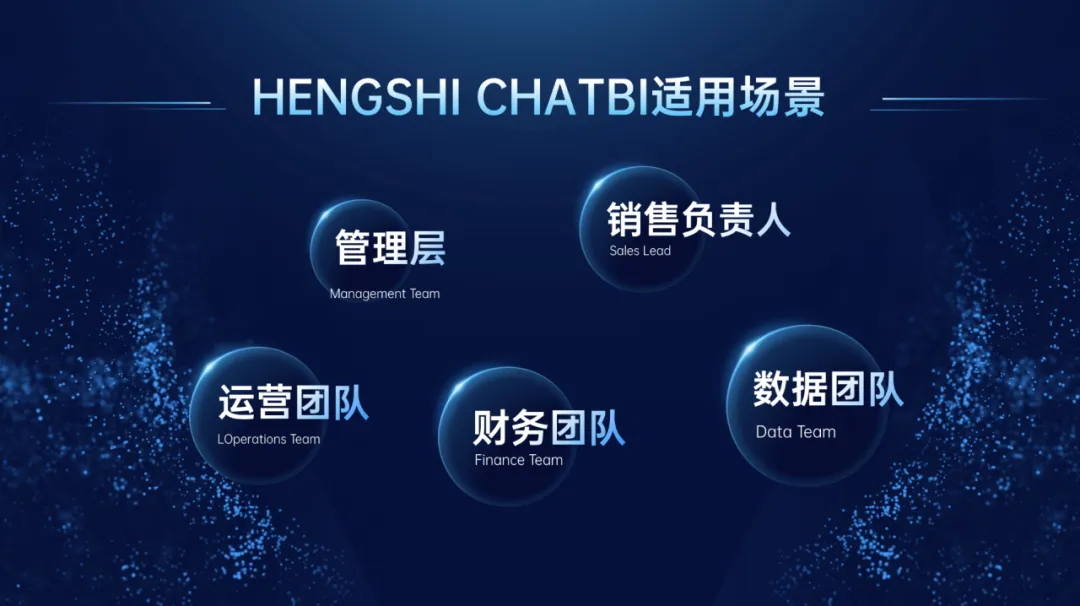
How ChatBI Changes Business Analysis
These problems were not unsolvable in the past. The main bottleneck was that the analysis chain was too long. ChatBI reconstructs the interaction path from asking a question to obtaining an answer, compressing three major waiting periods:
Waiting for analytics resources: Business teams submit requests, data teams schedule work, write SQL, build reports, and then the business side interprets the results.
Waiting for metric alignment: The same business concept may have multiple definitions, so discussion first requires confirming metric scope and calculation rules.
Waiting for review triggers: Anomalies stay inside reports until the next meeting brings them into discussion and action.
ChatBI turns these three waiting periods into a continuous, follow-up-friendly analytical process. The before-and-after differences for the four business problems are shown below:
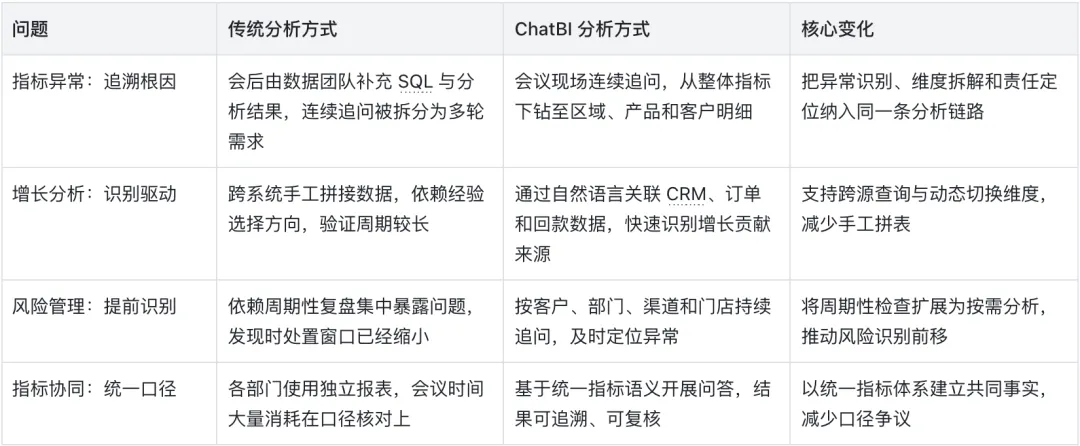
Mapped to business outcomes, ChatBI brings three core changes:
Earlier anomaly identification: Managers do not need to wait for weekly or monthly meetings; analysis can start as soon as business changes occur.
Immediate response to analysis needs: Business users no longer need to queue repeatedly for data requests. They can keep asking follow-up questions around the problem.
Unified decision definitions: Different roles discuss based on the enterprise’s unified metrics and permission system, reducing the cost of cross-department explanation.
ChatBI covers the complete process from discovering metric changes and explaining causes to forming action suggestions. This analytical chain directly affects decision speed, organizational coordination efficiency, and the quality of business judgment.
How HENGSHI SENSE Supports Production-Ready ChatBI
In production environments, ChatBI depends on platform capabilities such as natural-language interaction, business semantics, data governance, permission control, and analytics asset accumulation. Built on an enterprise BI platform, HENGSHI SENSE provides ChatBI with a complete technical foundation from data preparation to intelligent analytics delivery.
Unified Metric Semantics Keep Answers Trustworthy
Model capability, enterprise data semantics, and metric definitions jointly determine ChatBI accuracy. HENGSHI SENSE turns business definitions such as ROI, conversion rate, and repurchase rate into unified metrics, clarifying calculation rules, statistical scope, and data sources. It then maps natural-language questions to the corresponding metrics. When users ask the same question, the system generates auditable answers based on the same definition.
Business Semantics Help the Model Understand Enterprise Language
HENGSHI SENSE vectorizes and semantically indexes fields, metrics, and business enumeration values, enabling the system to match data objects by business meaning rather than literal keyword consistency. Enterprises can also use domain examples and human verification to map internal expressions such as “major promotion” or “small order” to clear business rules, continuously improving Q&A adaptation for specific scenarios.
Inherited Data Permissions Keep Analytical Boundaries Controlled
HENGSHI SENSE carries existing enterprise data permissions, metric definitions, and audit requirements into the ChatBI query process. The system limits accessible data based on user identity and generates answers within authorized boundaries, ensuring that different roles see results aligned with their responsibilities and providing a secure foundation for large-scale adoption.
Accumulated Analysis Becomes Reusable Data Assets
High-value Q&A should become organizational assets rather than one-off conversations. HENGSHI SENSE uses the business semantic layer to ensure consistency in AI queries and supports turning analysis results into charts, dashboards, data interpretations, and review materials. Enterprises can reuse these outcomes, reduce repetitive analysis, and gradually solidify front-line experience and management methods into shareable data assets.
Multiple Integration Forms Bring Analysis into Business Workflows
HENGSHI SENSE supports Web, iframe, JavaScript, React SDK, API, and integrations with Feishu, WeCom, and DingTalk bots. Enterprises can embed ChatBI into existing business systems and collaboration tools, allowing users to launch analysis directly in management meetings, project groups, and customer-facing scenarios.
An Integrated BI Platform Carries the Full Analysis Chain
Enterprise analytics usually involves data access, relationship modeling, intermediate aggregation, metric management, BI visualization, and intelligent Q&A. HENGSHI SENSE connects data integration, semantic modeling, metric systems, visual BI, and ChatBI into one unified chain: the platform first completes data preparation and governance, then ChatBI provides the natural-language analytical entry point. Software vendors, industry partners, and group IT teams can embed this capability into business systems while inheriting permission systems and continuously accumulating analytics assets.
Conclusion
Metric anomalies require root-cause tracing, growth requires driver identification, risks need to be discovered earlier, and cross-department decisions require unified definitions. In the past, these tasks depended on specialists to retrieve and explain data after meetings. Now, HENGSHI ChatBI allows more business users to ask follow-up questions, verify answers, and make judgments based on the same trusted data when problems arise. HENGSHI SENSE further brings business semantics, permission governance, and analytics asset accumulation into one platform, allowing natural-language analysis to enter enterprise business workflows and continuously improving organizational data-driven decision-making.