
Article body
Full article
Over the past two years, large AI models have rapidly entered every corner of the enterprise. From code completion to intelligent Q&A, from document generation to data analysis, AI tools keep raising individual productivity. Yet as adoption deepens, a practical problem has surfaced: most AI remains stuck at the “tool” stage. It can finish a conversation or generate a piece of code, but it rarely becomes part of how an enterprise builds software. Requirements still need human coordination, documentation still needs constant maintenance, and cross-team communication still consumes enormous amounts of time. Copilot improved individual efficiency, but it did not change how organizations collaborate.
On July 24, HENGSHI Technology held its product launch event and officially released HENGSHI JARVIS, together with the latest products including HENGSHI SENSE 6.3, HENGSHI CLI, and HENGSHI BOX. More than model capability itself, the event revolved around a different question: when AI truly enters the enterprise, how does it take root and grow into part of the organization? The pursuit of this question has pushed HENGSHI Technology’s product vision beyond the boundaries of data and BI, from business intelligence into the broader field of organizational decision intelligence.
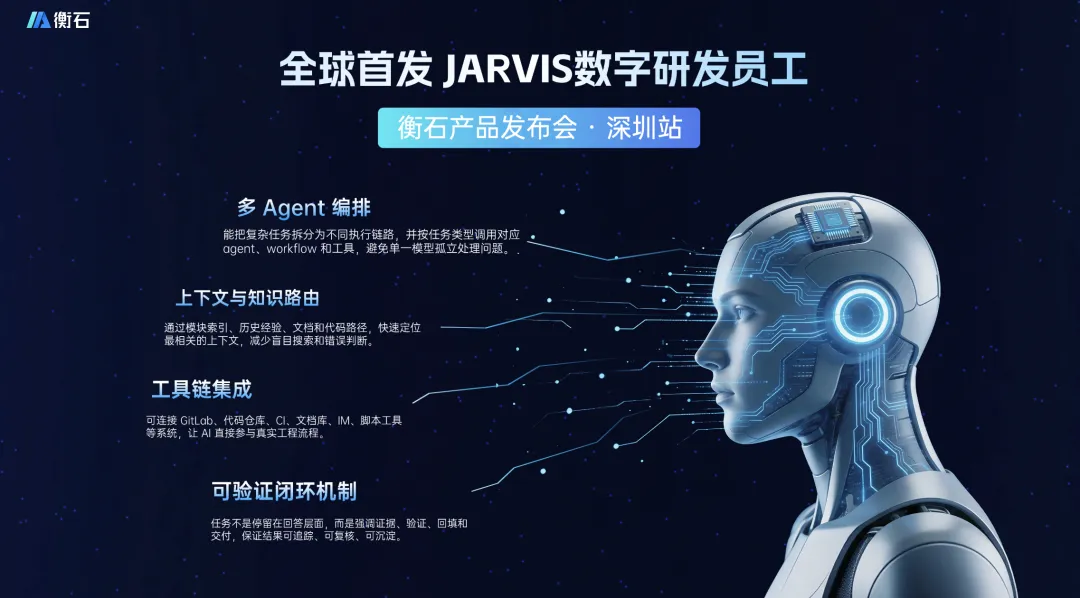
From “Assistive Tool” to “Digital Employee”: AI Takes the Lead in R&D
At the event, HENGSHI Technology CEO Liu Chengzhong shared the team’s internal practice over the past six months. Inside HENGSHI Technology, JARVIS is already connected to R&D tools such as GitLab, Jira, and Feishu. It can continuously advance tasks around work orders, autonomously complete standardized work including requirement analysis, bug fixes, code review, and documentation, and sync the results back into the R&D workflow. Within a few months, JARVIS participated in more than 200 bug-fix tasks, with an overall handling efficiency roughly 3.5 times that of a senior engineer.
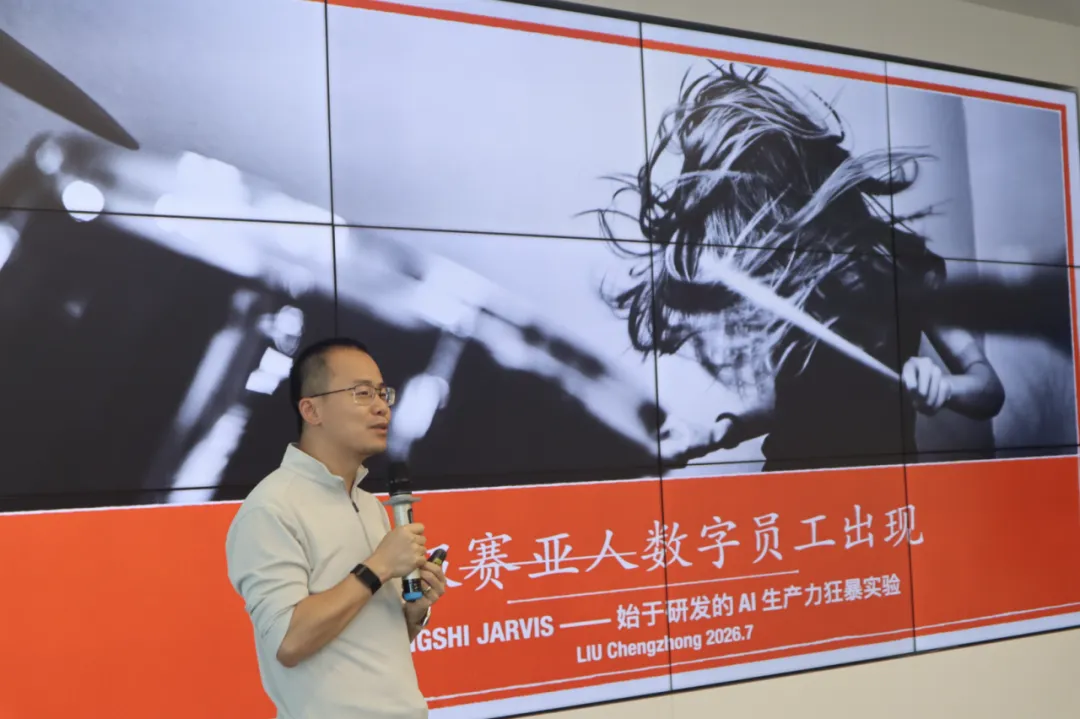
More notable than these numbers is the way of working that JARVIS represents. In the past, AI behaved like an on-call assistant: every interaction had to be initiated by a person, and the task ended when it was done. A digital employee, by contrast, has the ability to keep working — it advances continuously toward a goal, moves information across multiple systems, and executes tasks according to defined processes. AI no longer participates in just one operation, but in a complete link of the R&D process.
Liu Chengzhong argued that the biggest cost of enterprise R&D is not writing code, but repetitive organizational coordination: requirement synchronization, version confirmation, documentation maintenance, and cross-team communication. These tasks are highly standardized, yet they drain R&D teams’ time year after year. JARVIS takes on exactly this kind of work, while system architecture design, product planning, and business decisions that require creative judgment remain with people. A digital employee does not replace engineers — it redistributes the work each side does best, so the team can devote more energy to innovation and design.
The Real Barrier for Enterprise AI Is Not the Model, but Harness Engineering and Delivery
If the digital employee defines AI’s role in an organization, what really determines whether it can be delivered is the engineering system behind it. Liu Chengzhong also pointed out that many enterprise agents can run demos but struggle to enter production. The reason is not insufficient model capability, but the lack of enterprise-grade features such as permission management, process auditing, knowledge accumulation, and continuous operation. For enterprises, AI must not only “answer well” — it must be manageable, verifiable, and traceable.
To this end, HENGSHI Technology built the JARVIS-BOX runtime architecture. Instead of relying on a generic knowledge base, the enterprise knowledge layer continuously indexes code, work orders, design documents, and review records to form a proprietary knowledge system. The digital employee runs in an isolated sandbox with explicit permissions and can pause, resume, and re-execute tasks. High-frequency work such as bug fixes, metric development, and requirement analysis is packaged as standardized skills that are invoked on demand rather than through complex prompts. Every execution keeps a complete record, making code, data, and operations traceable end to end. Human review results and online feedback continuously flow back into the knowledge system, allowing the digital employee to accumulate enterprise experience over time.
Letting AI Move Freely Through the Organization: HENGSHI CLI Connects the Tool Execution Chain
HENGSHI SENSE 6.3, released alongside JARVIS, further strengthens the data foundation that digital employees rely on. The biggest change in this upgrade is the introduction of HENGSHI CLI. HENGSHI Technology Chief Data Scientist Chen Jiayao noted that while natural-language interaction lowers the barrier to entry, complex tasks in enterprise scenarios often involve multiple agents working together. Relying on conversation alone can easily introduce semantic deviation, increase model inference costs, and affect the consistency of execution results.
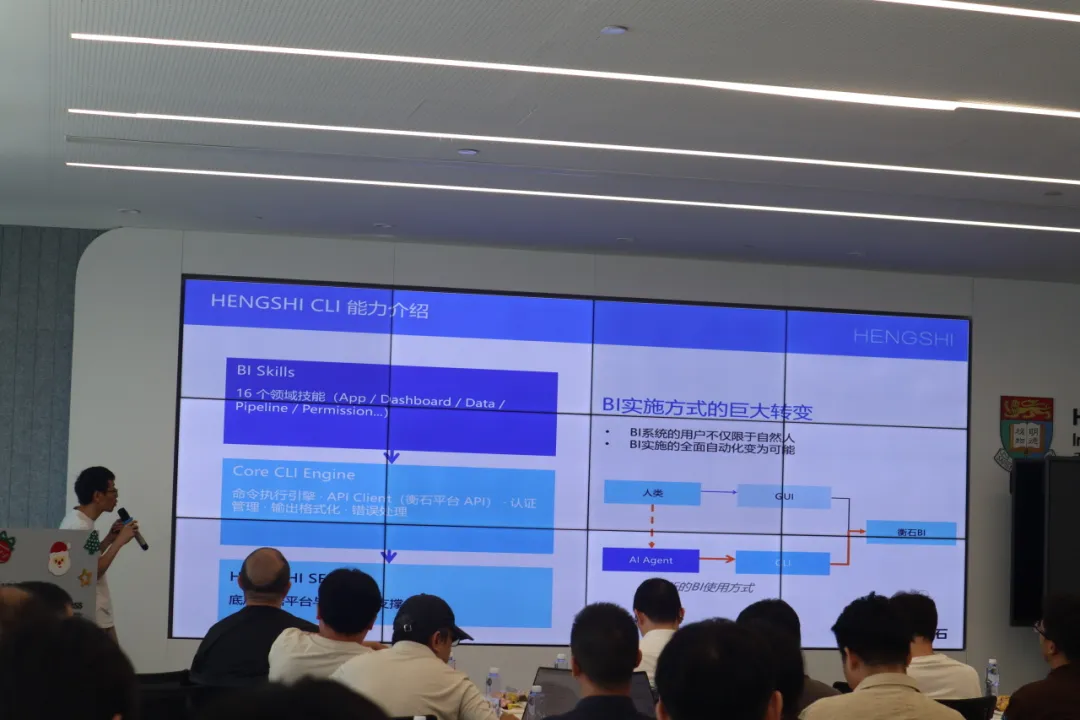
For this reason, HENGSHI Technology has packaged core capabilities — data modeling, metric management, dataset creation, report generation, and permission management — into a standardized HENGSHI CLI command system, turning capability calls that previously depended on natural-language understanding into deterministic command execution. Upper-level agents only need to understand business requirements and plan task flows, while the underlying layer completes standardized calls and returns results through the CLI, decoupling “planning” from “execution.” This design not only improves multi-agent collaboration efficiency, but also lets digital employees integrate more stably with existing enterprise R&D and data platforms, providing a unified, reliable capability interface for automated delivery.
The Foundation for Organizational AI: A Five-Layer Architecture and HENGSHI BOX
To bring digital employees into real enterprise production, HENGSHI Technology has built a complete five-layer architecture around knowledge, execution, security, and feedback. The enterprise cognition layer continuously indexes internal assets such as code, work orders, and design documents, helping digital employees build enterprise-specific knowledge rather than relying on a generic knowledge base. The isolated execution layer ensures safe task execution through sandboxes and permission controls. The skill execution layer packages high-frequency work such as requirement analysis, metric development, and code fixes into standardized skills invoked on demand. The governance and audit layer records task execution, code changes, and data access throughout the process, keeping every operation traceable and auditable. The feedback iteration layer continuously absorbs human review results and live operational feedback, refining the knowledge system and execution strategies so digital employees keep learning and optimizing as the business evolves.
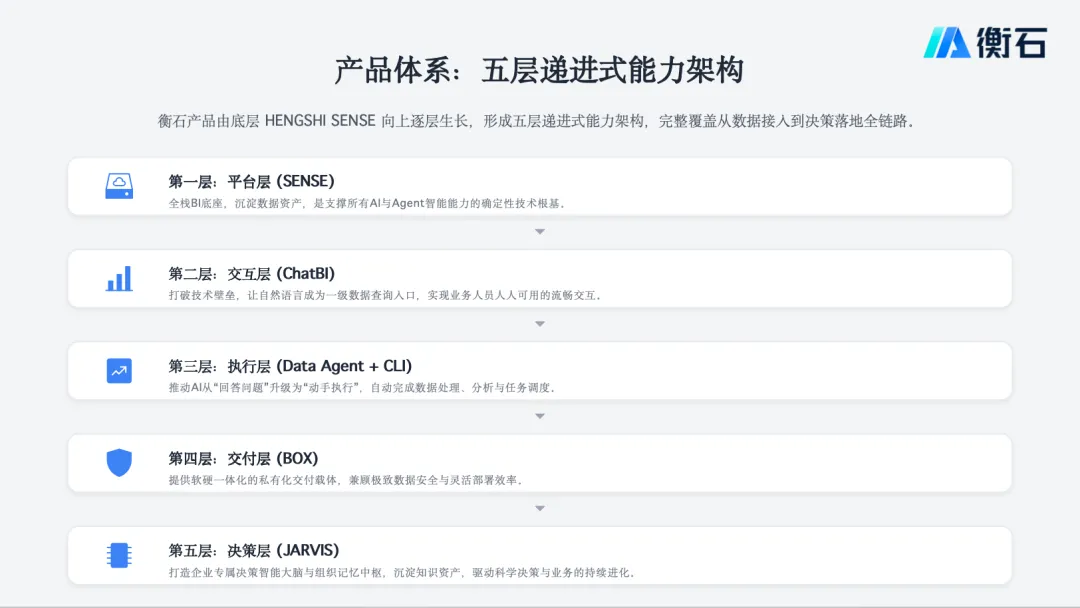
Supporting this architecture is HENGSHI BOX, released at the same time. It is not a hardware device in the traditional sense, but an integrated runtime platform built for enterprise digital employees. It combines model management, knowledge management, task scheduling, runtime environments, and security governance, providing JARVIS with a stable, controlled operating environment. Enterprises can quickly connect digital employees to their existing R&D, data, and office systems without rebuilding complex AI infrastructure — completing model deployment, knowledge accumulation, skill execution, and runtime monitoring under a unified permission system.
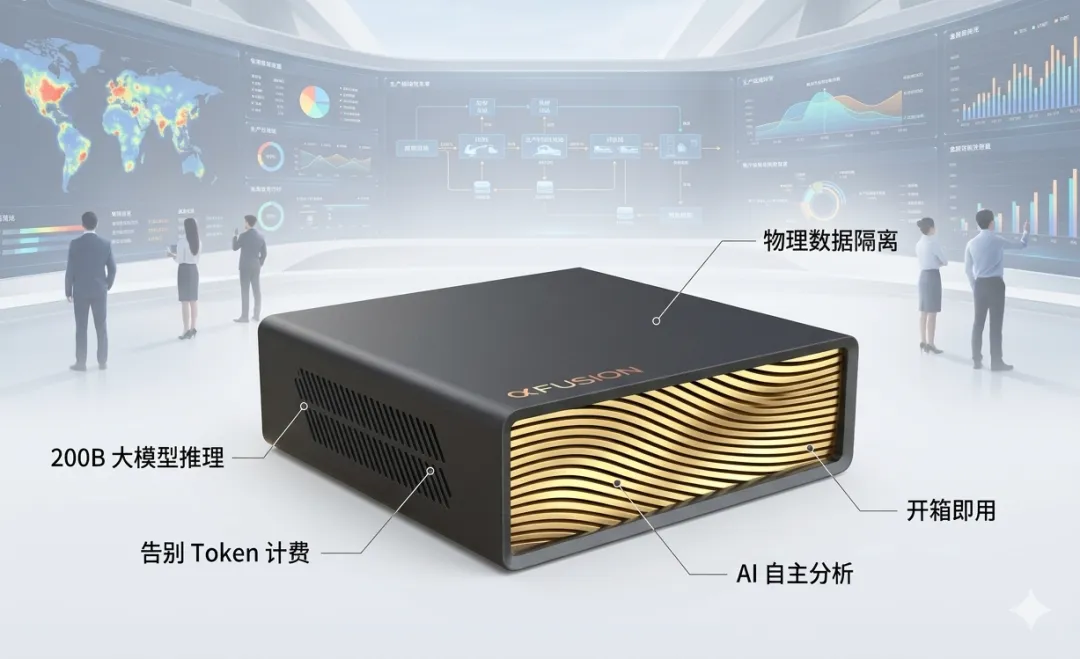
Through the synergy of HENGSHI BOX, HENGSHI SENSE, HENGSHI CLI, and JARVIS, HENGSHI Technology has built a complete product system covering the data foundation, the runtime platform, and digital employee applications — a sustainable, evolving Agentic BI infrastructure for enterprises.
Product Assets Can Also Be Continuously Maintained by a Digital Employee
Beyond the R&D workflow, the event also demonstrated another practice of digital employees in product management.
Many enterprises face the problem of scattered product assets as they grow: code, documentation, customer projects, and historical experience are disconnected from each other, so pre-sales, R&D, and delivery teams often work from different information. As versions evolve, the boundaries of product capabilities become harder and harder to map.
Ma Chi, founder of the AI pioneer community “Agents Special Zone” and known as “Swedish Horse Master”, proposed a reverse product specification method built on HENGSHI JARVIS to address this problem. The digital employee first extracts information automatically from code, historical requirements, product documents, and customer projects to build feature slices, then validates consistency against user journeys, and finally the product owner makes the business decisions. The bulk of retrieval, comparison, and organization is handled by the digital employee, while people take care of final confirmation — forming a product specification system that keeps itself up to date. Compared with one-off document organization, this approach is closer to continuously maintaining enterprise knowledge assets, and it lets pre-sales, R&D, and delivery teams collaborate on a unified information base.
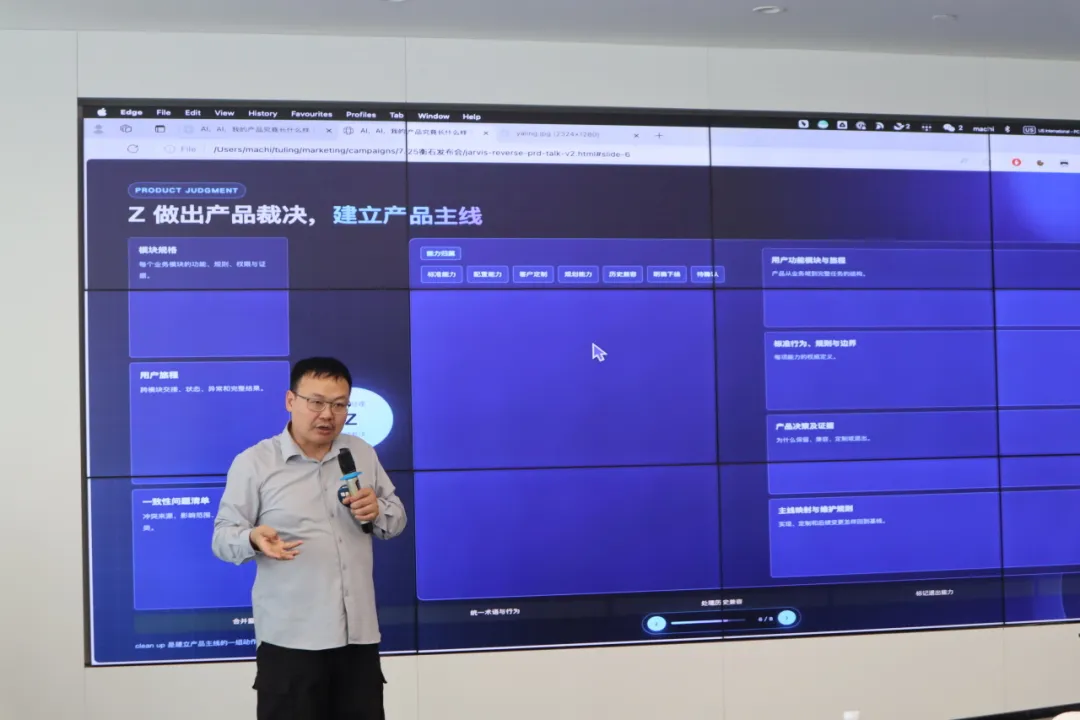
FDE senior expert Ma Chi (invited guest for this event): an AI technology observer and independent developer who follows large models, agents, AI programming, and enterprise intelligent applications. He continuously shares AI product practices, development experience, and industry trends, and is committed to exploring how AI lands in R&D organizations, enterprise software, and digital transformation.
The Essence of AI Adoption Is Redesigning How Organizations Run
The JARVIS, HENGSHI SENSE 6.3, HENGSHI BOX, and HENGSHI CLI released at this event are not independent products, but an enterprise-grade capability system built around the digital employee. From the data foundation and the runtime platform to standardized execution capabilities and digital employee applications, HENGSHI Technology is trying to answer a longer-term question: when AI becomes part of the enterprise, how should the organization collaborate anew?
Perhaps the next stage of enterprise AI is not about who owns the biggest model, but about who can get AI truly into the business, integrated into workflows, and creating value in real work, day after day.