
Article body
Full article
On October 10, an “AI+ Ecosystem Cooperation Forum” was held in the second meeting room on the twentieth floor of China Mobile’s Xi’an office. The event centered on the theme “Computing as a Foundation, Industry Exchange, Intelligent Adoption, and a Shared Future.”
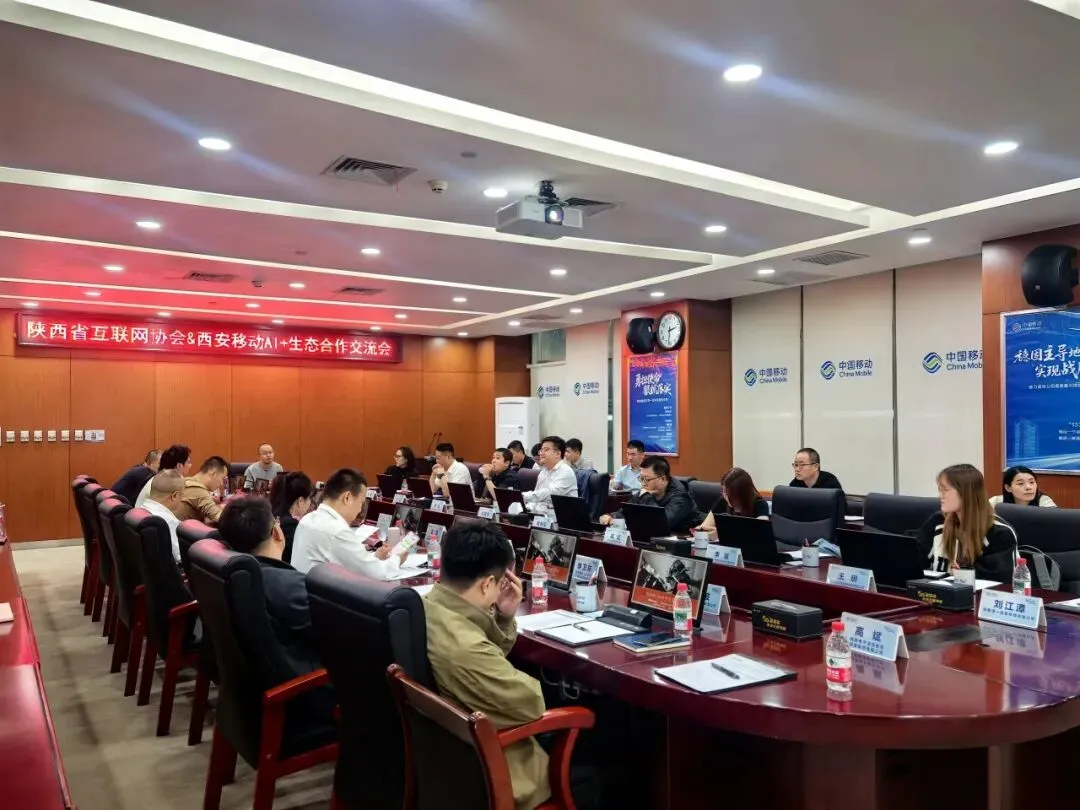
Liu Chengzhong, founder and CEO of HENGSHI Technology, presented “How Organization-Level AI Reshapes Team Collaboration.” Drawing on HENGSHI’s own R&D practices, he discussed how teams should adjust workflows, review mechanisms, and management when AI takes on tasks. HENGSHI JARVIS is the digital employee in this organizational experiment.
From Faster Coding to More Effective Teams
Coding agents already help engineers generate code, locate errors, and add tests more quickly. Yet an R&D task still moves from request to release through requirements confirmation, review, testing, and deployment. Teams exchange information, confirm ownership, and wait for feedback at each step. Time saved by one person may simply be spent on handoffs and waiting. As Liu put it, “Work is lost in the process.”
HENGSHI therefore placed JARVIS on the main path of R&D collaboration. It receives tasks, reads project knowledge, carries out fixes or development, submits results, and participates in subsequent validation and review. The team needs to see what step it has reached, what problems it encounters, and what it ultimately delivers.
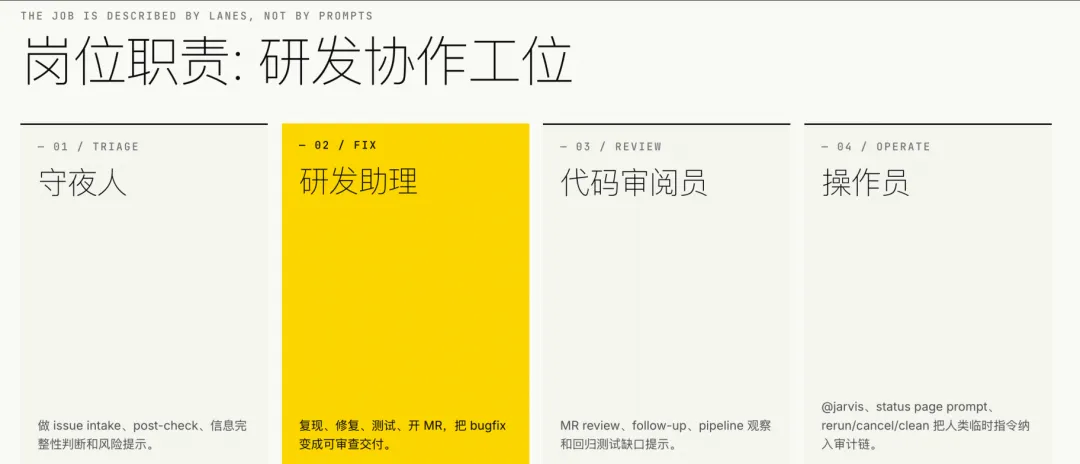
When AI can move work through the workflow, engineers have a chance to spend less time repeatedly asking for status, assembling context, and coordinating handoffs.
Building a Working System for Digital Employees
Liu described JARVIS as an “agent with its own agency”: it has an independent identity, can execute tasks autonomously, makes its work observable, and aims to complete assignments. To make this possible, an enterprise needs more than a model.
First comes organizational memory. A digital employee needs to understand project history, technical constraints, and earlier decisions, including why the team chose its current approach. HENGSHI organizes knowledge through indexes and files so agents can read what each task requires.
Second come working rules. Through Skills and Workflows, teams record methods, quality requirements, and the order of collaboration. This lets AI participate through existing entry points such as GitLab, Feishu, and email.
Continuous improvement is also needed. Teams find gaps during real execution, add knowledge and rules, and then verify whether the next task is handled better.
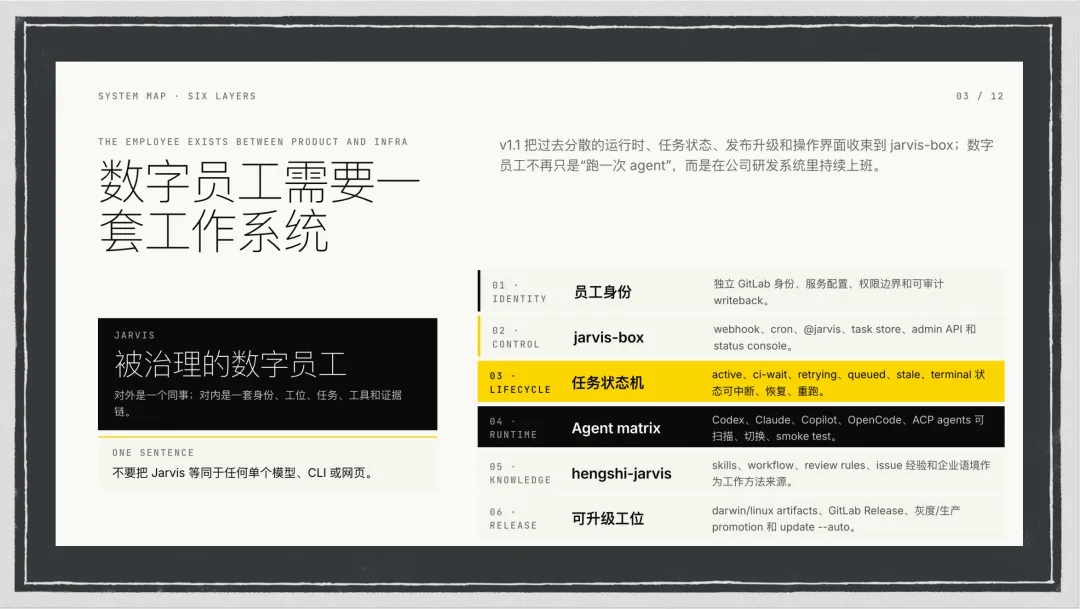
The path has four steps: build memory, train Skills, establish closed-loop Workflows, and create an improvement mechanism. Companies must invest time in clarifying how they work before a digital employee can understand tasks and take responsibility.
AI Takes on More Execution; People Keep Design and Verification
R&D is a suitable first use case because teams can verify the results. Issue descriptions, code changes, test results, and review records provide evidence for deciding whether a task is done. Engineers can also trace, correct, and roll back errors.
Liu warned that AI can offer plausible explanations for incorrect work. Independent testing and peer review must remain; a team cannot accept an agent’s account of its own work as proof.
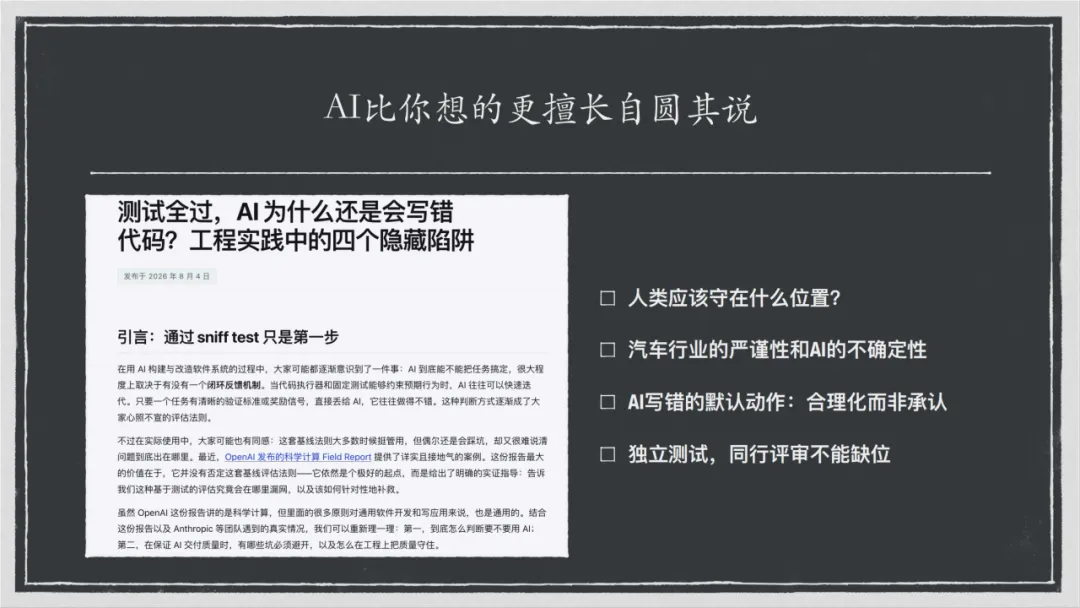
AI can already carry out substantial execution in bug fixes, tests, and routine feature enhancements. Large module design, architectural trade-offs, and original design still require people. Teams should set goals, constraints, and acceptance criteria before asking AI to implement.
Organizational Change Happens in Daily Collaboration
When a digital employee can follow tasks continuously, teams can reallocate people’s time.
Previously, engineers had to gather information from different systems, remind colleagues to act, and use meetings to synchronize progress. With JARVIS participating, some coordination can be assigned to an agent, while people check execution through process records and delivered results.
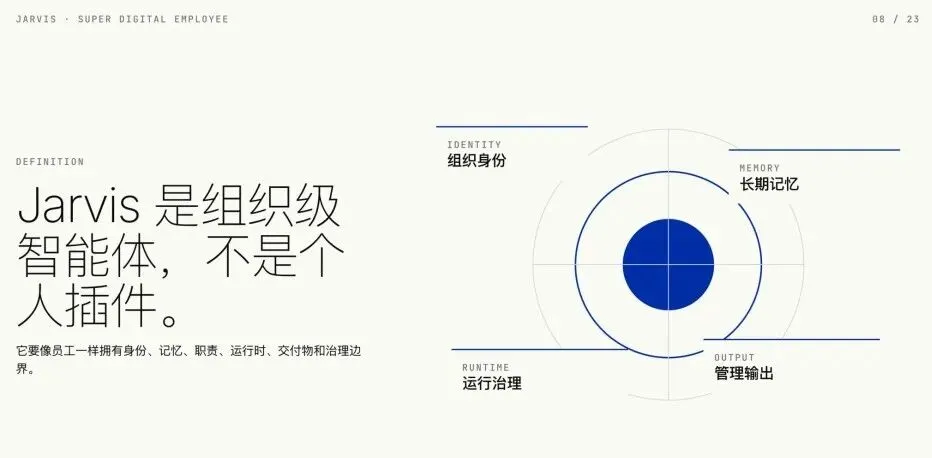
Liu summed up this approach as “define the rules up front, confirm the result afterward”: set task boundaries and quality standards in advance, retain human judgment at key points, and accept completed work against evidence. Managers can then spend less time chasing individual items and more time on requirements, design decisions, and collaboration problems. Teams also assess AI by its contribution to collaboration as a whole: not just how many tasks it finishes, but whether it reduces waiting and makes subsequent work flow more smoothly.
Start with One Scenario and Make Collaboration Work
Such a change starts with concrete work. Liu proposed creating a focused pilot area: choose a clearly bounded scenario, select participants, define task entry points and acceptance methods, and have FDEs work alongside the team to organize knowledge, tools, and processes.
The first JARVIS deployment cycle takes two to four weeks. Through real tasks, a team discovers what knowledge the agent lacks, which actions need confirmation, and where handoffs still rely on people.
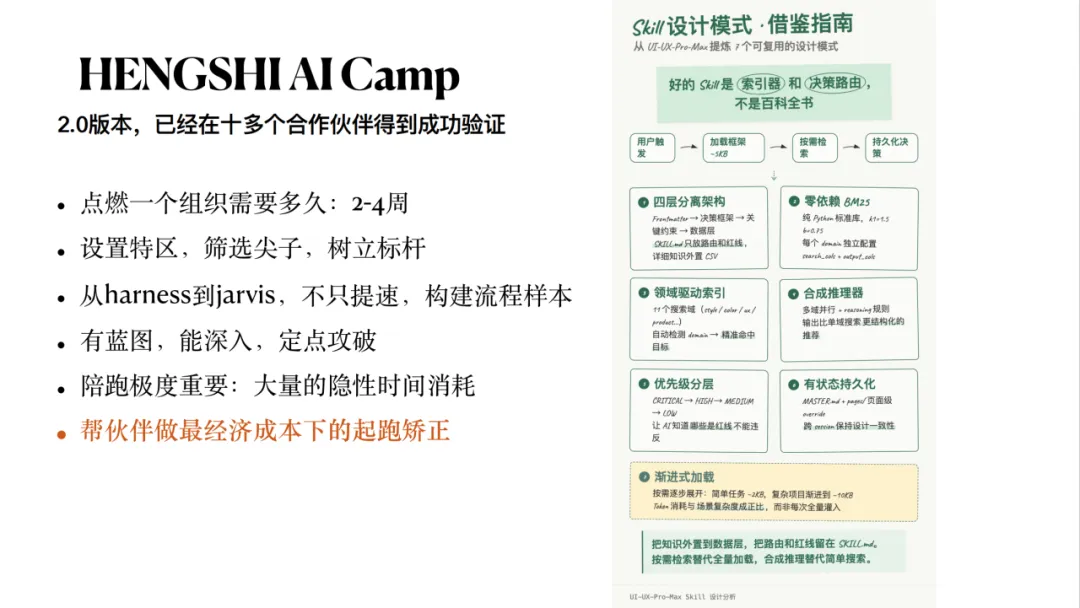
HENGSHI AI Camp supports this practical work. Its 2.0 version has been validated with more than ten partners. The focus is to help partners establish a working process example, then gradually expand its use. This shows enterprises how people and AI can divide work and what conditions make that division sustainable.
From Computing Supply to the Enterprise Workplace
At the forum hosted by China Mobile’s Shaanxi branch, Liu’s R&D experience offered an organizational perspective on intelligent adoption.
HENGSHI also hopes to explore cooperation with China Mobile and ecosystem partners in computing resources, the use of Token Plans in intelligent analytics, private model deployment, industry solutions, and joint market development.
These directions connect with HENGSHI’s existing data intelligence business. HENGSHI SENSE provides data integration, metrics modeling, visual analytics, and natural-language data queries. JARVIS goes further by exploring how AI can use organizational knowledge and working rules within continuously running business workflows.
Liu’s presentation brought the conversation inside enterprise teams. HENGSHI’s next step is to apply these lessons to more real customer tasks, where results can be checked, processes corrected, and each organization can gradually develop its own way of working with AI.