
Article body
Full article
A new generation of Agentic BI from HENGSHI Technology.
In an operating meeting, a manager opens a business dashboard and sees this month’s revenue, regional rankings, product mix, and year-on-year and month-on-month changes.
The numbers are already on the screen, but the real analysis has just begun.
“Why did East China revenue fall so quickly?”
“Was it fewer new customers, or a decline in repeat purchases from existing customers?”
“Which product lines dragged down gross margin?”
“Break out the abnormal customers, stores, and sales groups.”

These questions usually cannot be covered in advance by one fixed report. Business users see a result and immediately ask why. After seeing a cause, they continue to break it down by dimension, details, period, and anomaly. Reports provide the first layer of answers, but business decisions need an analysis path that can keep going deeper.
Over the past few years, many enterprises have completed data-platform and BI-system construction. Data sources are connected, metrics are organized, reports are published, and operating screens, sales dashboards, financial analysis, supply-chain monitoring, and operations reviews have become routine management actions.
But in real business settings, another problem remains: as reports multiply, business users still need to ask data teams whenever they want an answer.
This is not because BI has no value. On the contrary, reaching this stage means BI already carries the main capability for basic data consumption. Traditional BI helps enterprises establish unified definitions, preserve stable reports, control data permissions, support operating reporting, and let departments view the business through the same data system.
The problem is at another layer: reports are good at answering stable questions, while business users ask questions that change every day.
Today management cares about regional revenue. Tomorrow the sales leader wants to break down channel conversion. The next day operations wants to review repeat purchases after a campaign. A week later finance needs to explain gross-margin movement. Business questions keep changing with markets, organizations, customers, channels, and product actions. Reports can be designed in advance; follow-up questions do not follow the report catalog.
This creates a typical enterprise tension: data assets keep increasing, but the threshold for using data has not truly fallen.
Business users must first know which report to open, then decide which filter, dimension, and metric to use. Data teams must keep responding to ad hoc data pulls, chart changes, field additions, definition explanations, and analysis supplements. Over time, report systems become more complete, yet data Q&A still depends on a few data experts.
The value of ChatBI appears in exactly this scene.
It lets business users start from business language instead of from a report catalog.
A user can ask directly: “Which regions had the largest sales decline this quarter?”
They can continue: “Was the decline mainly from fewer new customers, or weaker repeat purchases?”
Finally, they can ask the system to “turn this analysis into a business review paragraph.”
This interaction looks like chat, but the underlying challenge is not simple chat. The core question for enterprise ChatBI is how to transform a natural-language question into a trustworthy data-analysis process.

In an enterprise, “this month’s revenue” is never a simple term. It may involve tax-inclusive or tax-exclusive definitions, order time or recognized revenue time, refund deductions, internal transaction exclusions, and permission limits. A user asks one sentence, but the system behind it must understand metric definitions, data models, permission rules, time granularity, and available analysis dimensions.
Without these foundations, a large model can easily guess based on field names or general experience. A short demo may look smooth, but long-term use can cause definition drift, permission leakage, and results that cannot be reviewed.
So the first principle of enterprise ChatBI is trust.
This is also a clear thread in HENGSHI’s product and technology evolution.
HENGSHI SENSE has long served enterprise software vendors, industry partners, and group IT teams. Its starting point is not a single reporting tool, but an enterprise-level AI + BI platform. It covers data integration, data preparation, logical modeling, metric management, visual BI, complex reports, embedded integration, multi-tenant delivery, and permission governance. Because these foundations are already in place, ChatBI can enter real enterprise scenarios instead of staying at the demo layer.
In HENGSHI’s approach, AI does not bypass the BI platform and guess SQL directly. Natural-language questions first enter the semantic layer, metric system, and permission system. Then the deterministic BI engine handles query, calculation, presentation, and reuse. The model understands questions, plans analysis paths, and organizes expression; the platform guarantees data sources, metric definitions, permission boundaries, and verifiable results.

Starting with 6.1, HENGSHI SENSE has pushed ChatBI toward a more complete Agentic Analytics experience. Data Agent not only answers questions, but also enters data creation, metric creation, dashboard editing, and intelligent interpretation workflows. Users can analyze around charts, or use intelligent interpretation configuration to let the system follow preset analysis ideas, query data, identify anomalies, decompose dimensions, drill down, and generate structured interpretation reports.
By HENGSHI SENSE 6.2 and 6.2.x, this path continued to deepen around business metrics and everyday analysis experience.
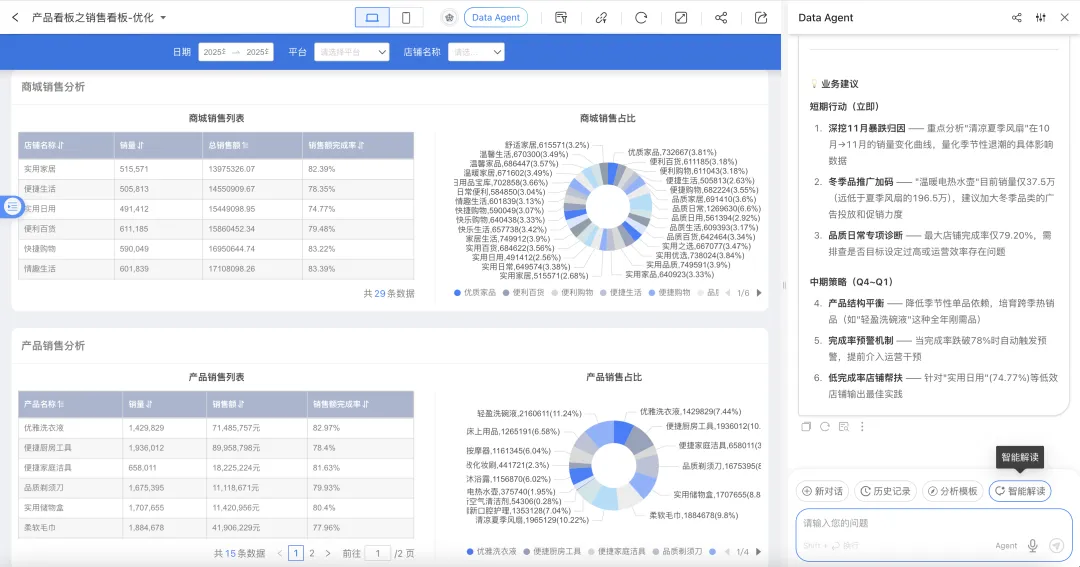
Business metrics can be favorited for quick access. Copying datasets across applications can include metrics under the dataset, reducing repeated configuration. Tables generated by ChatBI can preserve sorting rules when added to dashboards, making one Q&A result easier to turn into a reusable asset. Users who only use ChatBI can enter Q&A scenarios through an SSO default role, lowering the access threshold for business users.
HENGSHI SENSE 6.2.x further strengthens metric-driven analysis. Dynamic subject areas support charting with business metrics, and dashboard charts can select metric subject areas as data sources, then drag in metrics and analyzable dimensions directly. This means business users face not only fields and tables, but a governed enterprise metric system. ChatBI, metric analysis, and dashboard creation begin to work around the same business semantics.
Capabilities such as SSE real-time synchronization, long-text interaction optimization in Data Agent, thumbnails, and high-definition thumbnail APIs improve the product experience in embedded, portal, and intelligent-agent collaboration scenarios. For enterprise customers and software partners, ChatBI is no longer an isolated entry point. It can be embedded, integrated, permission-controlled, and preserved inside business systems.
This is the key point when HENGSHI discusses ChatBI: ChatBI is not a chat box added to BI; it changes enterprise data consumption from “find a report” to “ask a business question.”
Reports remain important. Management cockpits, formal reporting, periodic reviews, regulatory definitions, and complex formatted reports still need BI systems. ChatBI is better suited to frequent follow-up questions, anomaly localization, temporary exploration, cause decomposition, and business review.
When enterprises have unified metrics, a semantic layer, a permission system, and a verifiable BI engine, ChatBI can turn natural-language questions into trustworthy analysis. Managers can discover operating anomalies faster. Business leaders can spend less time waiting for data. Data teams can shift energy from repetitive request handling to metric systems, data models, and analysis-method construction.
If reports keep increasing but business users still cannot get answers, the issue is not a lack of data. The real gap is that the enterprise lacks a data-analysis entry point that is natural enough, trustworthy enough, and close enough to real business settings.
After HENGSHI SENSE 6.2, HENGSHI is connecting this entry point to existing enterprise data assets, metric systems, and BI engineering capabilities. The next step for ChatBI is not only making data Q&A more convenient, but helping more business roles truly enter the data decision-making process.