
Article body
Full article
Abstract: When enterprises introduce Agentic BI, what they truly need to accept is not whether it “can answer a number,” but whether it can turn a business question into a deliverable with clear definitions, traceable evidence, and explicit accountability, then advance the next step through authorized interfaces and processes. HENGSHI’s metric management, Data Agent, HENGSHI CLI, HENGSHI BOX, and JARVIS correspond respectively to semantic governance, analytical creation, engineering execution, private deployment, and Agent operations. This article presents an actionable closed loop from question, metric, and analysis to delivery, action, and retrospective review, while explaining which parts still need to be completed jointly through an enterprise’s publication, approval, and system-integration processes.
Define the boundary of a “closed loop” first. Data Agent already supports conversational analysis based on business data and can assist with metric creation, dashboard generation, and editing. External business actions such as “create a ticket,” “adjust a budget,” “initiate a purchase,” and “update CRM” require enterprises to design their integrations according to interface capabilities, identity authorization, and approval rules. Distinguishing the two makes it possible to realize value without delegating risk to a single natural-language instruction.
I. The Question Is Not Whether There Is an Answer, but Whether the Business Can Accept It
A natural-language data query can usually complete only the first step of finding clues. For example, if the answer to “Why did sales decline in East China?” does not state the metric used, reporting period, filters, data snapshot, and dimensions available for further checking, it is difficult for a business owner to judge whether actions should be adjusted on that basis. More commonly, the analysis ends without a responsible owner, due date, or review definition, leaving the insight in the conversation window.
Therefore, the delivery object of Agentic BI should shift from an “answer” to an “acceptable business conclusion package.” At a minimum, it must state the question, metric version, analytical scope, evidence, recommended action, risks, and review method. Business users retain decision authority, while the Agent moves high-frequency work—data retrieval, decomposition, comparison, organization, and expression—forward to a deliverable state.
1. The Same Metric Does Not Mean the Same Number in Every Scenario
Consistent metric definitions are the foundation of trustworthy analysis, but “the same metric always gives the same result” is not accurate. A calculation also depends on the reporting period, data snapshot or data-update time, filters, dimensional granularity, and the data permissions associated with the user’s identity. These conditions must be saved together in a review, rather than saving only the metric name. For generative AI, the same input should also not be assumed to necessarily yield exactly the same answer; the model version, retrieved context, data state, and follow-up process can all affect wording and the analytical path.
HENGSHI metric management emphasizes “define once, use everywhere,” using HQL to decouple data storage and computation from metric logic, and supports consumption around business metric systems, KPIs, and metric exploration. For complex definitions, they should preferentially be captured as reusable metrics: include rules such as the reporting period, whether refunds are deducted, and whether shipping fees are included in the definition and description; for easily confused concepts such as “repurchase rate” and “ROI,” maintain mappings from business terms to fields or metrics in data knowledge management. After a definition changes, dashboards, reports, embedded pages, and cached results should each be checked according to the enterprise’s publication, versioning, and refresh strategy. Do not assume that every reference will take effect automatically and immediately.
II. From Question to Action: A Six-Step Chain That Can Be Accepted
HENGSHI Data Agent’s product capabilities can support the analytical work in the first half of the chain: it uses user input to determine intent, decomposes questions as needed, and performs hybrid retrieval from data marts, application marts, and application-creation content within data the user is authorized to access. Complex questions can involve one or more data queries. It can also read the signed-in account and current-page information, thereby understanding context such as “my department,” and assist in creating metrics, dashboards, and visualizations. The value of these product capabilities is to connect business exploration back to existing data and BI assets, rather than treating natural language as a shortcut around governance.
Figure 1: Acceptance dimensions for Agentic BI; every dimension should leave inspectable evidence
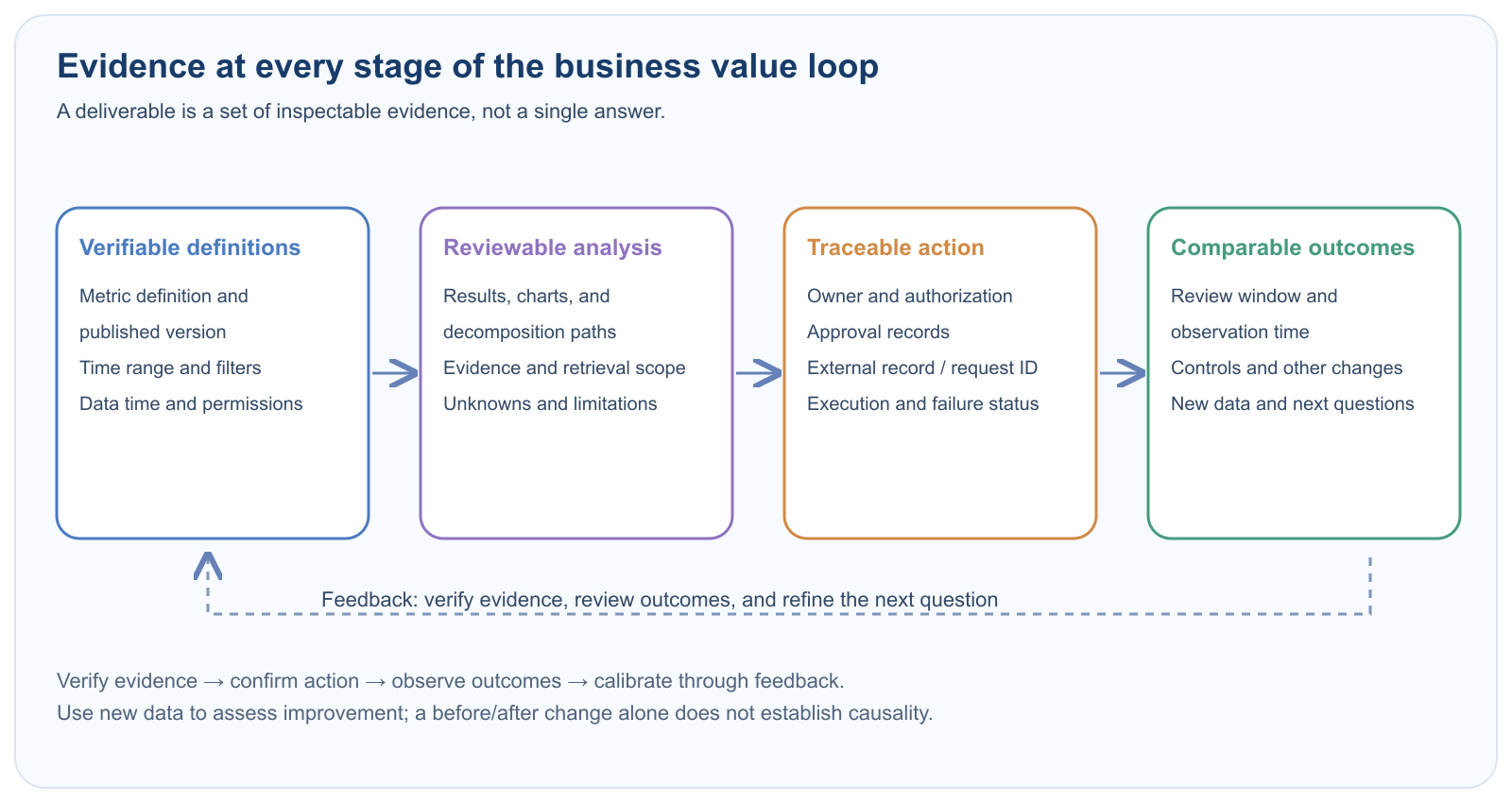
| Stage | Deliverable and HENGSHI capability | Acceptance question |
|---|---|---|
| 1. Define the question | Specify the business objective, responsible owner, and decision point; begin exploration in the current page or conversation. | Can the question be limited to a verifiable business hypothesis? |
| 2. Formalize the metric | Use a metric to carry complex definitions; complete field/metric descriptions, synonyms, filter rules, and version records. | Are the definition, time scope, permission scope, and data snapshot all complete? |
| 3. Multi-step analysis | Based on problem complexity, Data Agent performs queries, aggregation, anomaly identification, decomposition, and drill-down, then produces interpretations based on existing data. | Can every key conclusion be reviewed through a chart, metric, or detail record? |
| 4. Form the delivery | Generate dashboards, charts, explanations, or structured conclusions; the business side confirms the adopted conclusion version. | Who accepts the conclusion, and who will complete the next step by when? |
| 5. Act after authorization | Use the interfaces, approval, and permission mechanisms of existing business systems to send notifications, create tickets, or take other agreed actions. | Is the action within explicit authorization, and can the request, approval, and result be reviewed later? |
| 6. Review the outcome | Check results with the same metric and a new data snapshot, and supplement data knowledge and human-review feedback. | Did the action improve the objective, or do the hypothesis or definition need correction? |
2. Data Preparation Determines Whether Analysis Can Reach Business Context
Data Agent’s accuracy does not depend on the model alone. The HENGSHI 6.2 manual recommends using natural language in data-set knowledge management to describe the purpose of a data set, implicit filtering rules, synonyms, and mappings among business terms, fields, and metrics. Vectorization can also improve retrieval of industry terminology and context. For content produced by “intelligent learning,” the manual explicitly recommends manually checking it before adding, removing, or editing it. The principle is to let AI participate in learning and organization, while leaving final confirmation of business semantics to people who understand the business.
This also explains why implementation should begin with a small number of core metrics in one business domain. First organize naming, data types, field descriptions, irrelevant hidden fields, and metric descriptions; then introduce conversational analysis. Once the business team can review results consistently, expand to more data packages and more questions. Intelligent interpretation can perform real-time queries, anomaly identification, decomposition, drill-down, and report output based on preconfigured approaches, but it describes existing or historical data and should not be treated as future prediction or automated decision-making.
III. A Reusable Acceptance Case: Handling Declining Regional Sales
The following is an example and does not represent the facts of any customer. A retail team finds in its operating dashboard that “East China net sales” are below target, and the owner wants to decide at the weekly meeting whether to adjust channel resources. Rather than treating the “reason for the decline” as the only deliverable, the team should agree on acceptance criteria first and then let Data Agent and BI capabilities produce reviewable analytical material.
Business question: East China net sales are below this week’s target; do channel resources need adjustment?
Metric: Net sales (published version v2026.10)
Analytical scope: Calendar week; East China; direct-sales and distribution channels viewed separately
Review conditions: Data snapshot time, filters, user-permission context, and a link to the metric definition
Analytical delivery: Trend, channel/city breakdown, refund impact, anomaly notes, and traceable charts
Business decision: After owner confirmation, the channel owner submits a resource-adjustment request through the established process
Review date: The next calendar week; check the result with the same definition and a new data snapshot
During the analysis stage, Data Agent can query based on the current dashboard and user context, break down dimensions, and generate interpretive material. The team should require it to map conclusions to the charts, metrics, and filters used, rather than accepting only a natural-language explanation. If the refund definition or channel attribution is disputed, the correct action is to return to the metric definition and data knowledge, correct and publish them, and validate again—not to have the model temporarily “guess an algorithm” in the conversation.
During the action stage, the system can carry confirmed conclusions into existing ticketing, approval, or CRM processes. Whether a ticket is created automatically, who can approve it, and how failures are handled depend on the integration interfaces and enterprise governance design. HENGSHI CLI’s public command is hbi. It can organize BI engineering operations such as data ingestion, HQL queries, dashboard generation, and permissions into an Agent-callable command surface. For operations that support previews, it provides --dry-run and works with result echoing, making it suitable for human review before engineering changes. Here, HQL is part of analytical expression and metric logic; it is not a “task DSL” for writing business actions.
Outcome review should also record promotions, seasonality, customer-segment composition, and other concurrent changes. Where necessary, establish control conditions to distinguish changes in a metric after an action from the action’s own contribution, avoiding conclusions of causality based only on before-and-after comparisons.
IV. Phased Implementation: Make It Reviewable Before Making It Scalable
1. Phase One: Establish an Explainable Analytical Chain
Choose a frequent, low-dispute question such as regional sales, inventory turnover, or service response. Complete metric and data-knowledge preparation, agree on an acceptance card, and require every delivery to retain the scope, charts, metric version, and human conclusion. The acceptance criterion is that business users can recheck key conclusions under the same set of conditions.
2. Phase Two: Capture Analytical Results as Consumable Assets
Once review is stable, capture high-frequency analyses as metric dashboards, interpretation approaches, dashboards, and report templates. HENGSHI SENSE supports Data Agent in creating or editing dashboards from scratch, including charts, filters, rich-text reports, layouts, and batch operations on controls. The business team must still establish publication checks to confirm that different consumption entry points see the intended version.
3. Phase Three: Connect Business Processes Within Authorized Boundaries
Prioritize low-risk actions such as notifications, to-do generation, and material prefill, then pilot external operations that require human approval. HENGSHI BOX provides an integrated hardware-and-software private-deployment option that combines the BI platform, local models, and an Agent tool environment. When using a local solution, acceptance should explicitly define the model execution location, external network access, and data-transfer scope; when external models or services are connected, their data paths should also be checked item by item. JARVIS provides enterprise Agent operations methodology and consulting enablement to help teams build structured knowledge, workflows, quality gates, and continuous-improvement mechanisms. Enterprises can combine these capabilities as needed and separately agree on acceptance items for deployment security and workflow quality.
V. Conclusion: Deliver “Intelligence” as a Business Change That Can Be Checked
The value of Agentic BI is not having a system make decisions in place of people. It is enabling organizations to complete the cycle of “ask a question—use a unified definition—obtain reviewable analysis—form an acceptable delivery—act under authorization—review with new data” through a shorter path. HENGSHI’s metric management, Data Agent, BI engineering command surface, and deployment and operations methodology provide composable capabilities for this chain. Sustainable implementation still requires enterprises to include metric versions, data quality, publication strategy, approval interfaces, and accountability mechanisms in the design.