
Article body
Full article
一、When Should You Consider Migration
Not every enterprise needs to adopt Data Agent right now. Consider migration when two or more of these three signals appear simultaneously.
Report Development Backlog: The IT or data team’s report request queue has stretched to two months out, and business stakeholders are wasting significant time waiting for reports.
Metrics Governance Is Basically in Place: Core business metrics have completed at least one round of alignment—different departments more or less agree on what “sales revenue” means. If teams are still debating definitions, rushing into AI adoption will only make things worse.
Self-Service Analytics Demand Is High but Unmet: Business teams frequently ask for ad-hoc analysis (“Can you help me look into…”) but the data team can’t handle all requests. These exploratory, temporary analysis needs are the perfect use case for Data Agent—Agents are naturally suited for this kind of work.
If your enterprise shows at least two of these signals, you can start planning the migration.
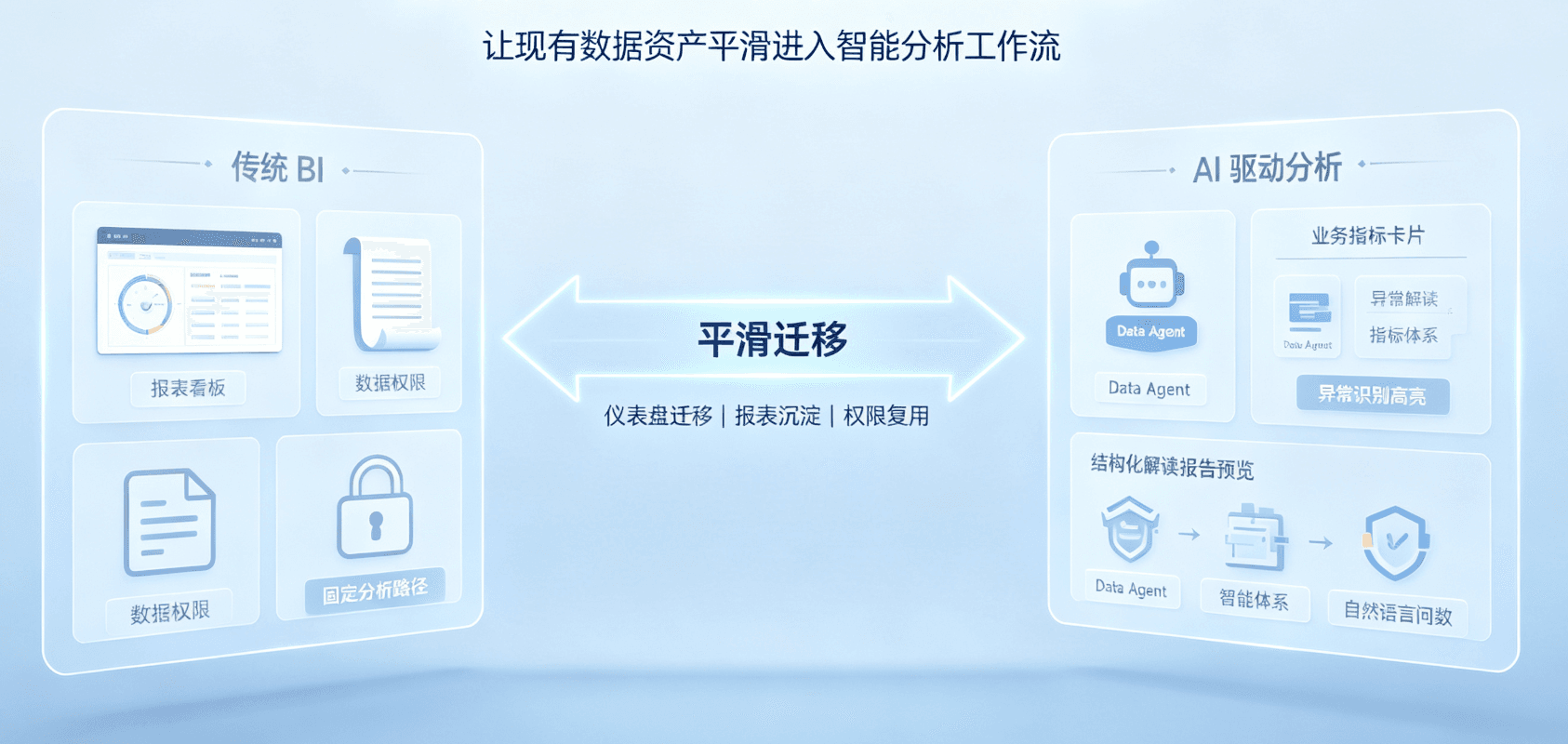
二、Migration Strategy: Capability Stacking, Not Replacement
2.1 Key Insight: Data Agent Doesn’t Replace Traditional Dashboards
Adopting Data Agent doesn’t mean cutting existing dashboards and reports. The value of Data Agent is to fill the self-service analytics gap, not replace the established fixed analysis system.
Traditional dashboards and reports will remain long-term. They are irreplaceable in standardized fixed analysis scenarios (financial monthly reports, management dashboards, compliance reports). The true incremental value of Data Agent lies in covering the ad-hoc and exploratory analysis needs that traditional BI can’t efficiently handle—answering questions you didn’t anticipate when designing the dashboard.
2.2 Phased Migration Approach
Phase 1—Metrics Foundation Validation (2-4 weeks). Do not deploy Data Agent at this stage. Instead, use Hengshi’s Metrics Platform to comprehensively map the existing BI metrics system. Organize the metrics and dimensions actually used in dashboards and reports into the platform and unify definitions. The most direct validation method: generate a control dashboard using the Metrics Platform that exactly matches an existing dashboard. If the data matches, the metrics system is reliable and you’re ready for the next phase.
Phase 2—Single-Point ChatBI Pilot (3-4 weeks). Deploy ChatBI for one high-frequency data query scenario in one business line. See whether business users can replace the “ask someone for data” habit with ChatBI. The key KPI at this stage isn’t accuracy rate—it’s whether business user usage frequency is growing naturally.
Phase 3—Deploy Visualization Creation Agent (4-6 weeks). Once the pilot runs smoothly, expand to more business lines creating their own dashboards with the Agent. You’ll notice the data team’s dashboard development pressure dropping significantly—not because the Agent replaces BI developers, but because it absorbs a large volume of simple dashboard requests from the development queue.
Phase 4—Full Rollout and Continuous Optimization. Roll out Data Agent across the company and establish daily operations and feedback mechanisms. At this stage, focus shifts from “how to get users on board” to “how to make it work better.”
2.3 Legacy Dashboard Handling Strategy
Three approaches can run in parallel: High-frequency dashboards are retained and incorporated into the new metrics-layer management system with high priority and continuous monitoring; For low-frequency dashboards where data is already covered by standard metrics, guide users to use ChatBI for ad-hoc queries instead of maintaining low-usage dashboards; Outdated dashboards are gradually archived after business stakeholders confirm a notice period, removing data management maintenance costs.
三、Key Challenges and Responses
3.1 Changing User Habits
The biggest resistance isn’t technical—it’s habitual. Business users are accustomed to “viewing” data on dashboards rather than “asking” data in natural language. The solution isn’t training—it’s creating “must-use” scenarios. Embed a ChatBI entry button on the dashboard page with “Want to dig deeper? Ask me, the AI,” letting business users encounter AI capabilities naturally within their existing workflow rather than forcing a habit switch.
3.2 Accuracy Trust Crisis
If users encounter inaccurate answers in their first few uses of Data Agent, they’ll quickly abandon it. The solution is transparency—show data sources and metric definitions with every answer so users can independently assess reliability; establish an efficient feedback channel so reported issues are fixed within days and released in the next update; regularly follow up with high-frequency users asking “what else are you unsatisfied with” and provide specific resolution timelines.
3.3 Metrics Semantic Layer Construction Cost
Building a metrics semantic layer does require upfront investment. Recommended approach: use automation to extract definitions of high-frequency metrics from existing dashboards and reports as a baseline index, then supplement with manual review for best efficiency. Hengshi’s Metrics Platform also has batch import functionality to accelerate this process.
四、Team Skill Upgrades
Traditional BI teams’ primary skills are SQL, ETL, and visualization design. The AI-driven era requires new skills: Metrics Modeling—evolving from “writing SQL to extract data” to “defining business metric definitions”; LLMOps—understanding Agent working mechanisms and being able to diagnose and fix common issues; Conversation Design—designing and optimizing Agent system prompts and conversation templates.
You don’t need to transform the entire team—just have 1-2 people master these new skills first as internal advocates to drive others.
五、ROI Evaluation Framework
Evaluate migration effectiveness across several dimensions. Dashboard output efficiency measures the proportion of business-side self-created dashboards; Report request response time measures the average time from business request to usable analysis results; Daily average number of ad-hoc analysis requests handled by the data team should decrease; Data consumption frequency measures the proportion of weekly active users who use ChatBI at least once; Data decision quality can be tracked through dashboard performance and actual contribution to business decisions.
Hengshi’s typical case data shows: self-service dashboard share increased from 5% to 35% (7x growth), average report request response time compressed from 3.5 days to 4 hours (95% reduction), data team monthly ad-hoc data requests down 60%.
六、FAQ
Q1: Will data be interrupted during migration?
No. Hengshi’s Data Agent is deployed incrementally—existing dashboards and reports continue serving, and Data Agent runs in parallel on a new channel, without affecting existing service stability.
Q2: Can we use ChatBI if the metrics semantic layer isn’t built yet?
Not recommended. ChatBI without a metrics semantic layer uses NL2SQL mode, with significantly lower accuracy and security than NL2Metrics mode based on a metrics semantic layer. Deploying ChatBI on an unstable metrics foundation easily causes business users to lose trust in AI—and rebuilding trust is much harder than building it from scratch.
Q3: Do we need to fully cleanse historical data?
No. Hengshi automatically adapts to existing data structures when connecting to data sources, without requiring full cleansing. You only need to define core metrics in the Metrics Platform; the data itself can remain as-is. Whether to migrate historical data depends entirely on analysis needs.
Conclusion
The migration from traditional BI to AI-driven analytics is fundamentally not a technology upgrade—it’s a evolution in working methods. From “people finding data” to “data finding people,” from “passively waiting for reports” to “proactively questioning data,” from “data team doing everything” to “business teams self-serving analysis.” Hengshi Data Agent provides the key infrastructure for this evolutionary path, and the true key to migration success lies in not rushing, progressing in phases, and achieving measurable business results at each stage.
This article is based on Hengshi Data Agent deployment practices.