
Article body
Full article
Enterprises want AI analytics in their business workflows while retaining control over where business data is processed. The delivery goal is to help business users find trustworthy data in a controlled environment, use consistent metric definitions, and apply analytical results to reports and business reviews.
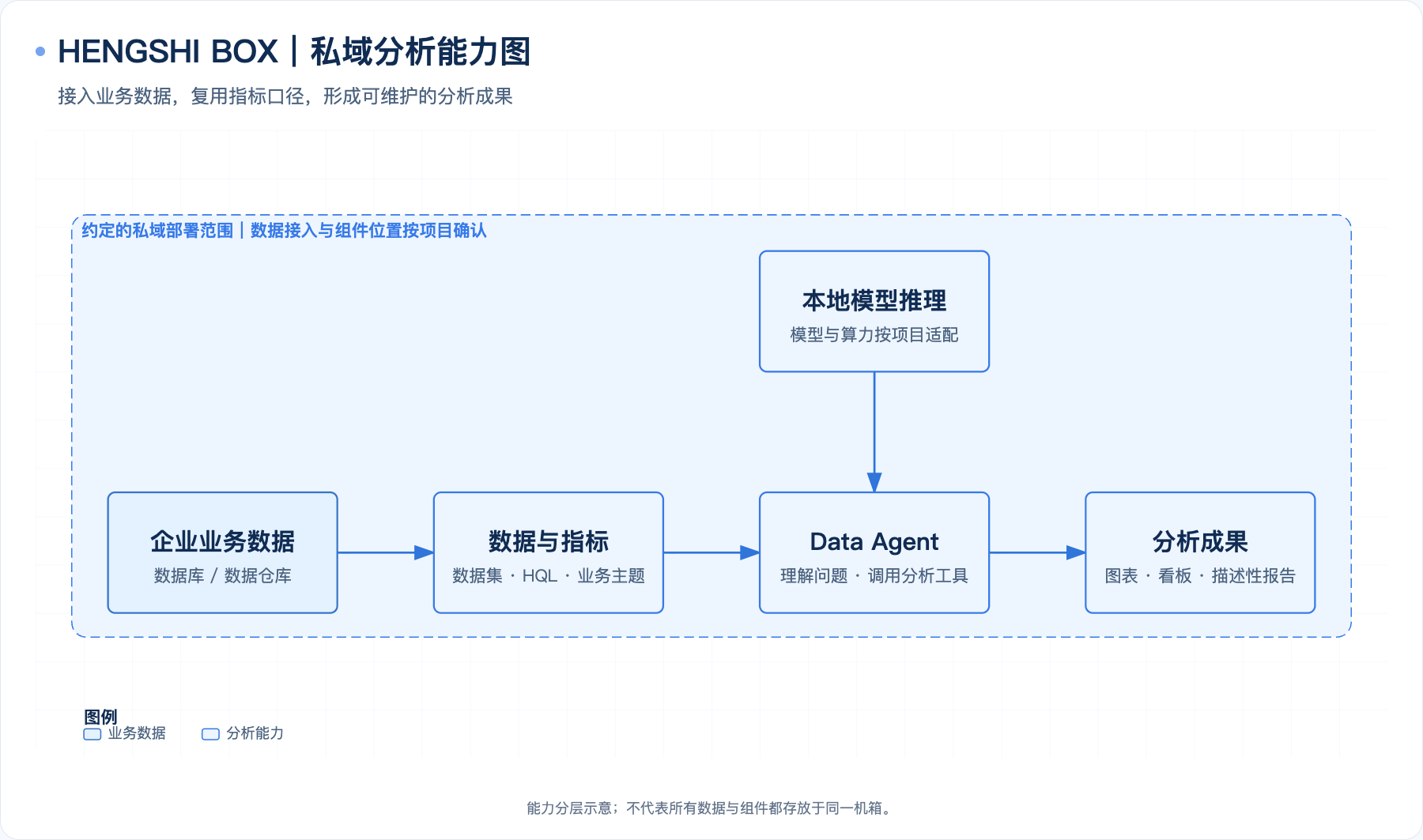
HENGSHI BOX combines HENGSHI’s data analytics capabilities with privately deployed models, providing an integrated hardware and software delivery option for Agentic BI in enterprise private environments. HENGSHI’s collaboration with xFusion brings server compute, the HENGSHI SENSE analytics platform, and local model inference together in one solution. Its value includes deployment integration, metric management, natural-language data queries, and analytical application development.
1. Connect Compute, Semantics, and Analytical Applications
A privately deployed model can interpret questions, but it does not inherently know how an enterprise defines revenue, which dataset is the authoritative source for a business review, or which access permissions apply. The analytics platform must support this work.
The delivery scope of HENGSHI BOX can be understood at three levels:
- Compute and model services: Provide inference and its runtime resources within the agreed private environment. Models, accelerator hardware, capacity, and dependencies are subject to project configuration and compatibility validation.
- Data and metrics: Connect business data through HENGSHI SENSE and maintain datasets, metric definitions, and business knowledge, so queries refer to analytical objects that can be inspected.
- Analytics and applications: Bring natural-language queries, charts, dashboards, and data interpretation into business workflows, enabling teams to edit, review, and use the resulting assets.
Integrated delivery can reduce separate procurement, deployment, and integration work. Business rollout still requires data connections, account authorization, metric confirmation, and scenario acceptance testing. Starting the equipment and delivering usable business analytics are separate milestones.
2. HENGSHI Supports the Full Analytical Workflow
| Analytical stage | HENGSHI capability | Business use |
|---|---|---|
| Data access | Connect business databases and warehouses; select synchronization, computation, and acceleration options for the project | Confirm sources, locations, and refresh methods within the existing architecture |
| Metric semantics | Maintain time, organization, refund, and other definitions in metrics; organize and authorize them by business topic | Query shared definitions and let the data team review their underlying logic |
| Analytical delivery | Data Agent assists with queries, HQL, metrics, and dashboard authoring; ChatBI can turn conversational charts into dashboards | Develop results into analytical assets that can be edited, reviewed, and used |
Reading note: Confirm data sources, metric definitions, and user roles before using results in business reviews.
For business reviews, intelligent interpretation can follow a preconfigured analytical approach to query data, identify anomalies, break down results, and drill down, producing descriptive reports from existing and historical data. It helps people organize evidence; it does not establish business causation or guarantee future performance.
3. A Manufacturing Analytics Scenario
The following is a solution demonstration, not a real customer case or a measured outcome. A manufacturer wants to analyze orders, deliveries, and inventory on its internal network. A production manager asks, “Which products’ delivery completion needs attention this month?”
The implementation team first connects the agreed data sources. Business owners confirm the definitions of quantities due, quantities delivered, and reporting dates, then place the relevant metrics in a delivery analysis topic. The Agent queries these objects and explores results by product, region, or period. After reviewing exceptions, business users can add confirmed charts to a business dashboard, or the data team can develop the dashboard further.
Acceptance testing uses roles such as planners, plant managers, and group managers to verify data scope, agreement with reports under the same conditions, and the need for clarification when a model cannot resolve a definition. This scenario illustrates how HENGSHI connects data, metrics, natural-language queries, and visual delivery. Benefits should be measured using actual records after rollout.
4. Verify the Complete Data Flow in Private Deployments
“Local inference” should describe a deployed and verified operating arrangement, rather than a conclusion inferred from a product name. Model requests, vector retrieval, and tool calls that must remain private should run within the agreed boundary, with network and access controls configured to enterprise security requirements.
Implementation teams should also verify the scope of logs, monitoring, backups, upgrades, exports, and third-party connections. If external services are enabled, specify what information is sent and who approves it. Strictly isolated environments require validated local solutions. Projects that permit external calls must separately define data and service boundaries; they cannot simultaneously claim complete isolation and unrestricted cloud calls.
Private deployment provides a basis for controlling processing locations. Account management, resource authorization, row and column permissions, and operational controls still require implementation. Disconnecting public internet access does not replace security assessment or verification of industry compliance requirements.
5. Validate Cost and Performance with Business Workloads
Local inference can reduce usage-based charges for external model APIs, but it does not eliminate operating costs. Total cost of ownership also includes hardware depreciation, software licensing, electricity, facilities, deployment and maintenance, model updates, and spare capacity. Economic comparisons should reflect usage frequency, concurrency, and maintenance conditions.
Performance assessment should distinguish model generation time, data query time, and end-to-end analysis time. Model size, context length, output length, concurrency, cache state, and the underlying warehouse all affect results. Projects should record completion times for representative questions, peak-load behavior, failures, and correctness against business definitions. Fixed millisecond figures or universal accuracy rates without test conditions should not be treated as commitments.
After a model upgrade, retest tool calls, metric interpretation, chart results, and data scope. Existing metrics and analytical assets remain useful, but interface compatibility does not mean every behavior will remain identical after a model change.
6. Start with One Topic and Deliver Reusable Analytics
Begin with a business topic such as sales, inventory, or delivery. Define data sources, metric owners, user roles, and result review methods, then deploy privately and test the scenario. After acceptance, organize metrics, dashboards, analytical approaches, and sample questions as the foundation for wider adoption.
HENGSHI BOX delivers privately deployed models together with HENGSHI’s existing analytics system. Enterprises can build metrics, query data, and develop dashboards in their own environments. Business, data, and technical teams must maintain these assets together to turn an AI demonstration into an analytics service for everyday use.