
Article body
Full article
This article is for engineers and technical managers using AI Coding Agents for BI development, providing an in-depth breakdown of HENGSHI CLI’s 16 repo-managed skills across Foundation, Data & Semantics, Delivery, and Automation domains, helping you achieve full-chain automation in AI Agent-driven BI engineering.
1. Why the CLI Needs a Skills Suite
In the AI Agent era, BI engineering is no longer a purely manual operation of “opening an interface and clicking around.” When coding agents like Claude Code, Codex, and OpenClaw take over BI development tasks, they need a programmable, reviewable, and orchestratable execution surface — this is the core value of HENGSHI CLI.
The problem: cramming hundreds of commands and parameters into a single long prompt causes the Agent’s context window to balloon rapidly, with output quality dropping off a cliff. Hengshi’s design philosophy is clear: split complexity by resource domain, breaking BI engineering into 16 independent skills, each responsible for one clear responsibility domain.
This approach offers three key benefits: reduced Agent cognitive load (each skill’s prompt fits on one screen, so the Agent won’t get “lost”), reusable plug-and-play design (Claude Code, Codex, OpenClaw, and Hermes Agent can all follow the same skill boundaries), and a help-first convention (each skill defaults to checking help before executing, avoiding parameter guesswork).
2. The 16 Skills at a Glance: Four Domain Breakdown
Hengshi organizes the 16 skills into four natural BI engineering domains.
Foundation Domain (Base Layer) contains four skills. hbi-core handles authentication, preference settings, output format, and terminology management. hbi-app manages application space administration. hbi-permission handles permission governance. hbi-user-mgmt handles organization and user governance.
Data & Semantics Domain contains four skills. hbi-data handles connection and dataset management. hbi-data-modeling handles Join models and semantic modeling. hbi-indicator-center manages subject area metrics. hql-expert handles HE and HQL expressions.
Delivery Domain contains four skills. hbi-dashboard handles dashboard generation. hbi-dashboard-taste handles page aesthetic design. hbi-data-alert handles chart alerting. hbi-data-agent handles Data Agent backend governance.
Automation Domain contains four skills. hbi-pipeline handles ETL integration. hbi-notebook handles Notebook execution. hbi-scheduler handles schedule governance. hbi-workflow handles cross-domain runbook orchestration.
Let’s dive into each one.
3. Foundation Domain: Helping the Agent Stand on Solid Ground First
hbi-core: Authentication, Preferences, and Terminology Management. This is the first gate for an Agent accessing the Hengshi platform. It doesn’t handle business data, but it determines whether the Agent can “get in,” what identity it uses, and what format it speaks in. The Agent can check authentication status (view authentication provider, user identity, and token expiry time), set default output format (Agent-friendly JSON structured output), and query current preferences (output format, timezone, language region). The security design highlight is that tokens are not written to local config files but instead go into the system Keyring (macOS Keychain, Linux Secret Service, Windows Credential Manager) — so even if the Agent’s runtime environment is compromised, sensitive credentials won’t leak in plaintext.
hbi-app: Application Space Management. In Hengshi’s multi-tenant architecture, an “App” is the basic isolation unit for business analytics. Each App corresponds to an independent analytics space with its own datasets, dashboards, metric systems, and permission policies. The Agent can list all applications (view App ID, name, status, and creation time) and view App details.
hbi-permission: Permission Governance. Enterprise BI permission management is far more than just “who can see what.” It covers multi-level authorization from datasets and dashboards down to individual chart elements. The key design is the dry-run mechanism — any authorization operation by the Agent must first go through a dry run that outputs a preview of “what will happen if executed,” then requires human confirmation before execution. This fundamentally prevents the security risk of an Agent “taking initiatives” to modify permissions.
hbi-user-mgmt: Organization and User Governance. You can list user groups and add users to groups, with all operations also supporting dry-run confirmation.
4. Data & Semantics Domain: Turning Data into a Language the Agent Understands
hbi-data: Connection and Dataset Management. This is the starting point for the entire BI engineering. The Agent can list all data connections (view connection ID, type, host address, and connection status) and view dataset details (number of metrics, number of dimensions, and associated data connections).
hbi-data-modeling: Join Models. In real business scenarios, data is often scattered across multiple datasets. This skill supports querying and exploring cross-dataset association models. The Agent can explore data model relationships (specify dataset and exploration depth) and understand data lineage between tables.
hbi-indicator-center: Subject Area Metrics. Hengshi’s metric management adopts the philosophy of “define once, use everywhere.” This skill manages the business metric system by subject area. The Agent can view the subject area list and metric details.
hql-expert: HE/HQL Expressions. This is one of Hengshi’s core technical differentiators. HQL (HENGSHI Query Language) and HE expressions are Hengshi’s metric query languages, enabling the Agent to express complex business logic without needing to understand underlying SQL. The Agent can directly convert natural language intent into HQL queries. Why is HQL particularly friendly for AI Agents? Because SQL requires understanding table structures, field names, and JOIN relationships (a “black box” for the Agent), whereas HQL is based on a pre-defined metric semantic layer — the Agent only needs to call semantically registered metrics and dimensions, avoiding the Agent “hallucinating” incorrect SQL syntax.
5. Delivery Domain: Turning Analytics Assets into Deliverables
hbi-dashboard: Dashboard Generation. This is the core skill of the Delivery domain. It’s not simply “create a page” — instead, the Dashboard Plan mechanism first has the Agent output a reviewable plan, then execute creation. The typical workflow: the Agent reads the current App context (datasets, metrics, dimensions), then generates a planning document (describing dashboard layout, chart types, and data mappings). After human review and confirmation, the Agent applies the plan to create the dashboard, finally pushing changes to the frontend interface in real-time via SSE.
hbi-dashboard-taste: Page Aesthetic Design. This skill focuses on the dashboard’s “aesthetics” rather than “functionality.” The Agent can apply themes (such as Modern style) and view available theme lists. This ensures that dashboards generated by the Agent are not only data-accurate but also visually appealing.
hbi-data-alert: Chart Alerting. The Agent can create alert rules (specify dashboard, chart, trigger conditions, and notification channels) and view the alert list.
hbi-data-agent: Data Agent Backend Governance. This is the entry point for managing Hengshi’s AI analytics agent (Data Agent) configuration. The Agent can view Data Agent configuration and update Agent prompt templates.
6. Automation Domain: Bringing BI Engineering into CI/CD
hbi-pipeline: ETL Integration. The Agent can create data pipelines (specify data source, destination, and scheduling strategy), view pipeline status, and trigger pipeline execution.
hbi-notebook: Notebook Execution. The Agent can execute Notebook analysis scripts and view execution history.
hbi-scheduler: Schedule Governance. The Agent can create scheduled tasks (specify name, scheduling strategy, and execution action) and view the task list.
hbi-workflow: Cross-Domain Runbook Orchestration. This is the “conductor” among the 16 skills. It orchestrates composite tasks across multiple domains. The workflow definition file uses a structured format to describe the step sequence, with each step specifying the corresponding skill and command. The Agent first performs a dry-run to confirm correctness before execution.
7.实战:Agent Three-Phase Workflow
Hengshi CLI divides the Agent’s BI engineering workflow into three phases.
Phase 1: Understanding the Current Analytics Context. The Agent first learns about data connection status, dataset composition, data model structure, and validates query capabilities. The skills in this phase are called in order: hbi-core, hbi-data, hbi-data-modeling, and hql-expert.
Phase 2: Generating Deliverables. The Agent plans dashboard layout (defining name, theme, data mapping, and layout structure in the planning document), then applies the plan to create the dashboard, and finally adjusts theme and styling. The skills involved include hbi-dashboard, hbi-dashboard-taste, and hql-expert.
Phase 3: Bringing in Security and Delivery Rhythm. The Agent sets permissions (dry-run first, then execute), creates scheduled refresh tasks, and creates data alert rules. The skills involved include hbi-permission, hbi-scheduler, and hbi-data-alert.
8. SSE Real-Time Sync: Making the Agent’s Work Visible to the Business
CLI doesn’t lock results in the terminal. Through the SSE (Server-Sent Events) mechanism, every operation by the Agent in the CLI is pushed to the frontend interface in real-time. This means the Agent executing in the terminal doesn’t mean business people are left in the dark — every data refresh, chart update, and permission change is visible to business users on the frontend in real time. Human-in-the-loop is not post-hoc review, but real-time collaboration.
9. Engineering Value Summary of the Skills Suite
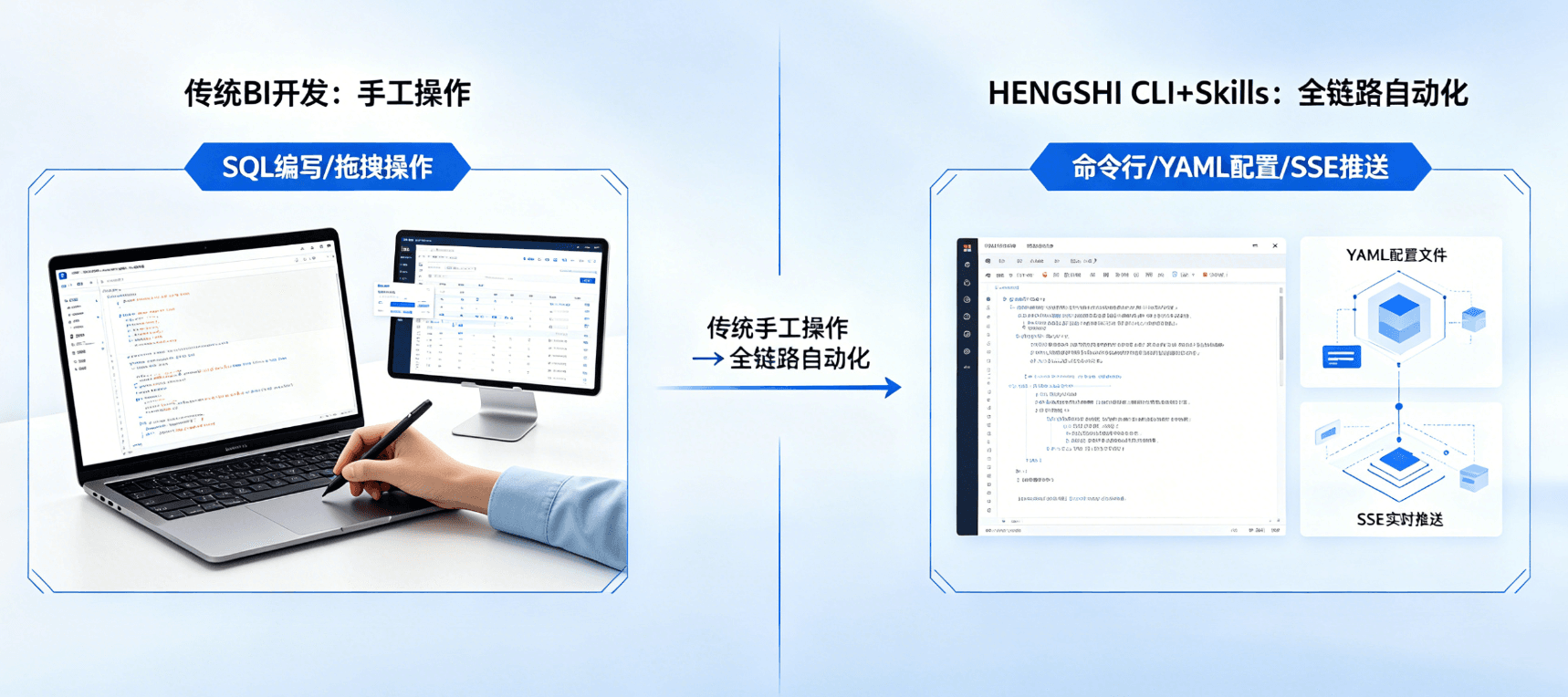
In traditional BI development, authentication requires manual login to the web interface, data access is configured through interface clicks, metric definitions require handwritten SQL, dashboard creation is done through drag-and-drop manual operation, permission management is configured line by line in the backend, scheduled tasks are configured in the interface, cross-domain orchestration requires manual coordination of multiple modules, and change visibility requires refreshing the page to view. HENGSHI CLI plus the Skills Suite transforms all of this into: OAuth or SSO with automatic Keyring-based authentication management, command plus structured output for data access, HQL semantic layer queries for metric definitions, Dashboard Plan YAML plus automated apply for dashboard creation, authorization commands with dry-run mechanism for permission management, command-line management for scheduled tasks, unified runbook for cross-domain orchestration, and SSE real-time push to frontend for change visibility. The transformation from manual operation to full-chain automation is the core value of the Skills Suite.
10. FAQ
Q1: What’s the difference between the Skills Suite and calling APIs directly?
APIs are atomic interfaces — the Agent needs to understand hundreds of endpoints, parameter combinations, and call sequences. Skills are semantic wrappers around APIs — each skill’s prompt encodes the domain knowledge of “in what scenario should what be done and how,” so the Agent doesn’t need to assemble API call chains from scratch.
Q2: Does the dry-run mechanism slow down the Agent’s execution speed?
A dry-run is just an extra parameter call that doesn’t add substantial waiting time. But it adds a critical security review point, preventing the Agent from “acting first and reporting later” in production environments.
Q3: If I don’t use an AI Agent, are the Skills useful to me?
Absolutely. The Skills’ command tree structure also applies to manual operations — you can execute commands directly in the terminal, skipping the Agent entirely is completely feasible.
Conclusion
HENGSHI CLI’s 16 Skills Suite is essentially structured encoding of BI engineering knowledge. They are not simple command wrappers, but domain knowledge of “how to do BI development well” solidified into reusable capability units in an Agent-consumable form. For teams exploring AI Agent-driven BI development, understanding the responsibility division and collaboration relationships of these 16 skills is the key to truly unlocking Agent productivity.