
Article body
Full article
When two models answer business questions, one common problem is that the same question, such as “What were East China’s net sales last month?”, resolves to different metrics. One model assigns refunds to the refund date and the other traces them back to the order date. Both can produce a number. Keep the definition, business date, organizational scope, and data permissions in verifiable assets before selecting a model for each task.
1 Three layers of responsibility
| Layer | What it carries | What to verify |
|---|---|---|
| Business semantics and data | Metrics, datasets, field descriptions, business calendars, and user data permissions | Calculations reconcile after a model change when identifiers, filters, and snapshots are the same |
| Model services and enterprise routing | Provider, service endpoint, model, protocol parameters, and permitted network boundary | Availability, tool calling, and structured output compatibility |
| Analytics entry point | Questions against a designated source, a multistep Agent, or a configured Workflow | Supported actions and how exceptions are handed off |
Semantic assets give a query a verifiable basis. The model can interpret language, find relevant resources, and formulate explanations. The system needs to record which metric and filters it uses. In open exploration, Data Agent can find analytics assets the signed-in user can access. For frequent, structured work, evaluate a designated source or Workflow. Verify supported behavior at the actual UI or API entry point and version.
Models interpret language and metrics define verifiable calculations
In “sales for my region last month,” the authorized identity defines “my region,” the business calendar defines “last month,” and “sales” must resolve to a clear metric. Check these three choices first during a model change. When the metric, parameters, batch, permissions, and database rounding match, compare the number and its evidence. This helps locate differences in interpretation, permissions, and data latency.
Maintain organization-wide financial rules in the authoritative model or data specification. Verify parameters, tool protocols, and tuning in the applicable model configuration. Pass the current scope, necessary fields, and relevant history into the conversation. When switching models, check compatibility with existing tool definitions and whether old definitions in the chat history affect a new query.
2 Test a real task after testing connectivity
In HENGSHI’s Agentic BI portfolio, HENGSHI SENSE provides analysis data, metrics, permissions, and a Data Agent entry point, with configuration for cloud or private model services. HENGSHI BOX provides deployment options for private analytics and local inference. For multiple models, specify the application’s model configuration, approved data paths, and acceptance criteria for switching.
Model provider settings accept the service endpoint, model, and required credentials. Services compatible with the OpenAI API format can use the documented compatible configuration. General settings cover timeouts, retries, the number of context messages, and provider-specific request parameters. Once the network and endpoint respond, test actual question answering, modeling, or visualization for constraint adherence, tool calls, parameter structure, and error handling.
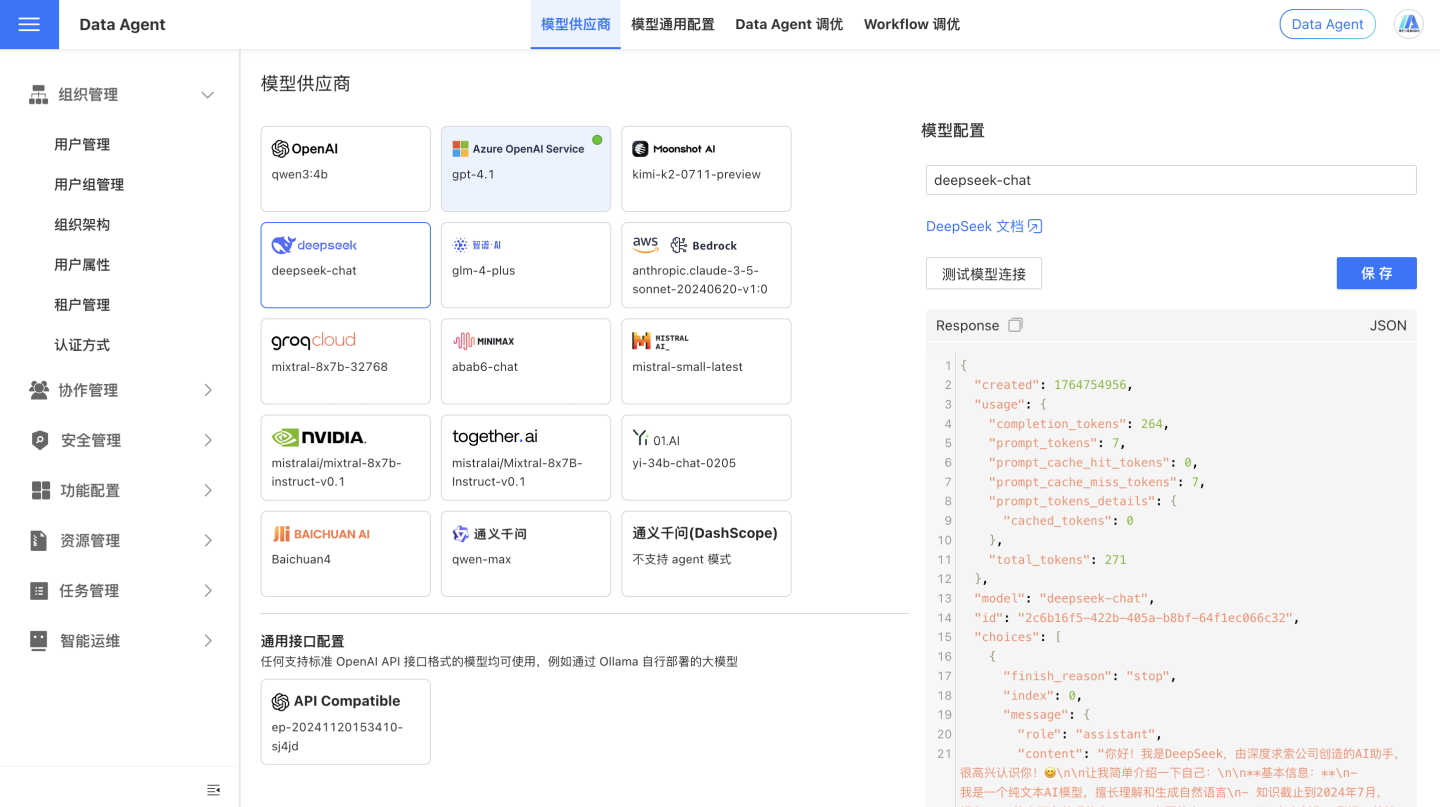
HENGSHI product documentation | Testing connectivity in model provider settings
Start with tasks already checked in the business dashboard: an explicitly named metric, an ambiguous alias, a metric with two filters, a request outside the user’s permissions, and a multistep question. Record the selected asset, scope, and output for each model. Keep the connection test as an integration record and measure accuracy, latency, retries, and manual verification for model selection.
3 Express routing as business constraints
Define allowed entry points for production. For sensitive data, establish the permitted deployment boundaries and services, then compare tool capability, cost, and latency among eligible models. For question answering, measure metric consistency and traceability. For modeling, verify expressions and joins. For visualizations, check dimensions, measures, and meaning. Track time to a usable first answer for interactive tasks and completion and review times for batch reports.
This illustrative configuration expresses approval and fallback conditions on the enterprise integration side. Application deployment, a gateway, or external orchestration can implement it.
scenario: regional_sales_review
data_class: internal_sensitive
allowed_model_profiles:
  - approved_private_model
on_private_model_unavailable: pause_and_notify_owner
check_before_delivery:
  - metric_definition_matches
  - regional_filter_matches
  - snapshot_is_complete
Private model services can still have dependencies outside the private network. Check embeddings, external tools, logs, proxies, egress, and fallback. The enterprise approves which data can go to cloud models. If a private model is unavailable, wait or hand off to a person. A fallback crossing the boundary requires an approved policy.
Measure the cost of a usable deliverable
Measure model charges and allocated compute, retry time, and human review. For cloud models, use actual project rates and concurrency. For private models, include utilization, peak queues, maintenance, and capacity depreciation. A cheap first response may cost more overall if it consistently needs clarification or correction. Use a realistic mix of tasks and time the first verifiable result, complete delivery, and recovery.
For output used in financial reporting or business operations, verify the source fields and model settings and record which outputs remain usable after exceptions. Operators should be able to identify the provider, model, task type, and failure class for a call. Log only approved fields and required identifiers for sensitive requests. Have an owner review model and routing changes, then rerun and assess the same examples.
4 Run regression checks on the same questions after a model change
Suppose Finance uses the refund date for the last two complete calendar months, the regional account can see only East China, and the reference dashboard is closed through last month. Ask both models the same question with a fixed data version. Compare the metric, month, region, refund date field, and result. Explanations can vary. The same metric, filters, and batch should produce reconcilable amounts.
| Test | How to exercise it | Passing evidence |
|---|---|---|
| Ambiguity | Offer both order-date and refund-date metrics | The definition is explicit or a business owner confirms it before values are shown |
| Data scope | Ask the same question with headquarters and regional accounts | Both queries and deliverables respect each identity’s scope |
| Provider outage | Simulate a private-model timeout | The service, error, and approved handoff are recorded |
| Cost and latency | Repeat the same set of long and short tasks | First result, full delivery, retries, and review effort can be compared |
Start by verifying one workflow. Keep semantics and permissions stable and record how the model changes understanding, execution, and output. A common baseline helps decide when to use a cloud model, private deployment, or the existing model.
Verify switching and fallback before rollout
Test the new model with an isolated configuration and sanitized examples, then compare low-risk business tasks and record the acceptable use cases. Diagnose service timeouts via availability, timeouts, and fallback conditions. For an incorrect interpretation, check the chosen metric, filters, and scope. If policy permits fallback, verify the model and permissions, rerun the original batch, and link the first failure.
| Checkpoint | Evidence to keep | Owner |
|---|---|---|
| Before the change | Current model, application mode, business baseline, and deployment boundary | Implementation owner confirms settings and business owner approves definitions |
| Comparison run | Actual queries, failure types, duration, and manual changes | Analysts reconcile results and operations diagnoses issues |
| Controlled cutover | Effective scope, time, and available fallback | Responsible owner acts within the approved boundary |
| After cutover | Repeated results and exception records | Data and operations teams review |
As usage grows, maintain evaluation sets and cost baselines by scenario. Routine questions, visualizations, and long-running analyses use different tools, so measure stable results for each before committing resources.
About HENGSHI
Founded in 2016, HENGSHI develops Agentic BI for the Data + AI era. Its enterprise analytics platform, HENGSHI SENSE, works with the HENGSHI JARVIS digital employee, the HENGSHI CLI execution engine, and the privately deployable HENGSHI BOX. With a decade in BI and a Powered by Hengshi partner ecosystem, HENGSHI supports software vendors across industries and provides private, trusted AI analytics for business operations and decision-making in manufacturing, finance, retail, public services, and other enterprise settings.