
Article body
Full article
I. The Security Dilemma of Enterprise ChatBI
The value of ChatBI is undeniable, but when you’re ready to promote it at scale within an enterprise, the first question that will likely stop you from the security team is: “Where will our data be sent?”
This is not unfounded paranoia. Most ChatBI solutions need to send users’ natural language questions to cloud large model APIs (such as GPT-4, Ernie, or Tongyi Qianwen). After the large model generates SQL, it’s executed locally and results are returned. On the surface, queries are executed locally, but the user’s original question may contain sensitive information — “How much was Zhang San’s commission last month?” — this question itself reveals the employee’s name and business focus.
For finance, government, healthcare, military, and other heavily regulated industries, such data transfer is unacceptable. Even for non-regulated enterprises, concerns about data security and trade secret protection make them cautious about public cloud large model APIs.
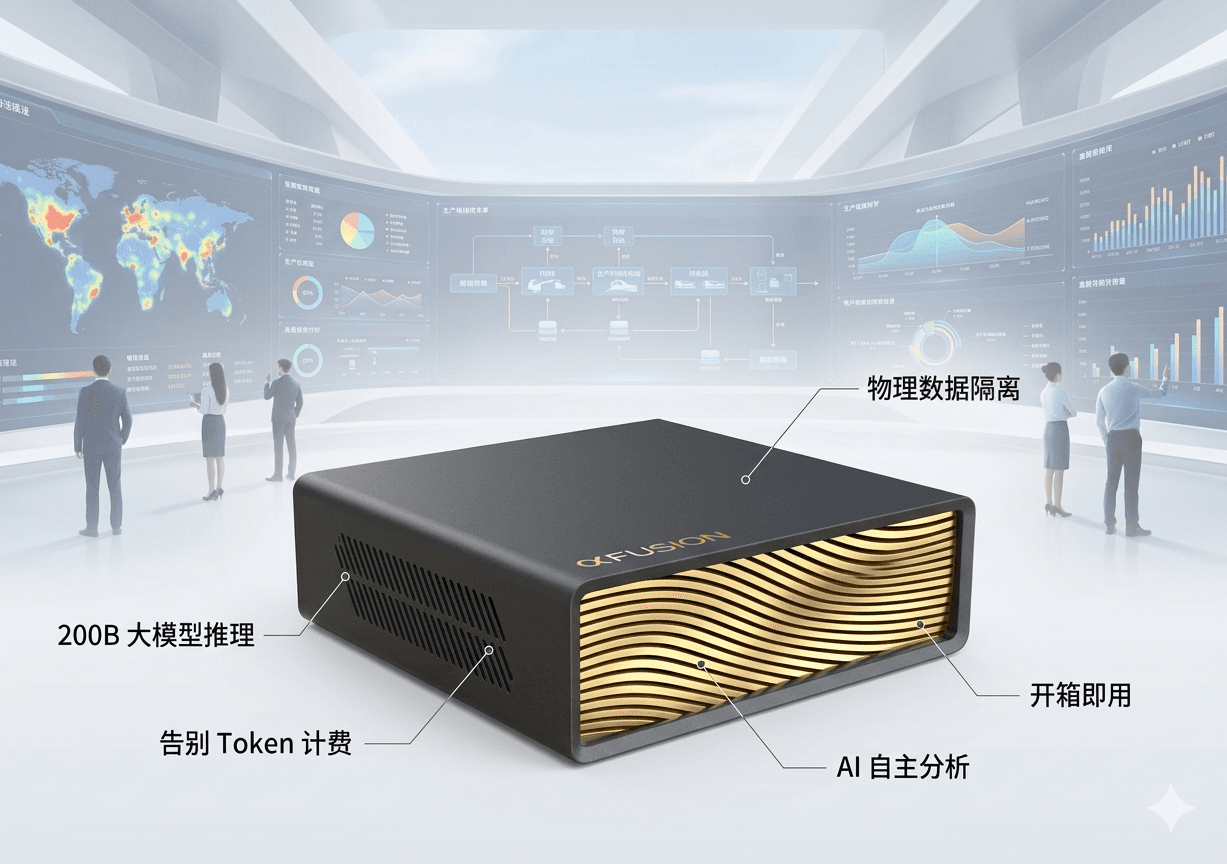
HENGSHI BOX is designed for this scenario — all AI inference and data computation happen inside one physical device, with data never leaving the chassis.
II. Product Positioning and Core Philosophy
HENGSHI BOX is a hardware-software integrated intelligent analytics product deeply co-developed by HENGSHI and xFusion. It deeply encapsulates a BI analytics platform, private large model, and Agent automation engine into one hardware device, with the core positioning of “a private secure enterprise-grade ChatBI solution.”
Core philosophy: “Give every metric its own digital pilot”
The “digital pilot” here is the built-in AI Agent — it understands your data structure, comprehends your metric definitions, can autonomously complete data analysis tasks, and all these capabilities run within a physically isolated device.
Experience promise: “Rack it, power it, start analyzing”
No complex installation and configuration, no additional software procurement and deployment, no need to connect to cloud services — just plug in power and network, and you can start using it.
III. Four Core Advantages and Their Technical Implementation
Advantage One: Agentic BI Autopilot
HENGSHI BOX has a built-in HENGSHI CLI terminal execution layer. AI Agents can autonomously trigger BI engineering actions like data connection, metric modeling, and dashboard generation through CLI. This is not “Q&A only” ChatBI — it’s true “autopilot” — Agents can complete full asset construction and operations within the BOX like professional BI engineers.
Complete chain from conversation to execution:
User natural language command
    ↓
Local large model understands intent and plans execution steps
    ↓
Invoke HENGSHI SENSE API via HENGSHI CLI
    ↓
Complete data connection, modeling, and dashboard generation
    ↓
Results echoed to frontend interface via SSE in real time
Advantage Two: Physical-Level Data Security
This is HENGSHI BOX’s most core differentiated capability. All natural language processing, large model inference, and data computation are completed within the BOX in a closed loop.
Technical implementation highlights:
- Locally deployed large model, no external API calls
- Vector database also inside the BOX, RAG retrieval never leaves the device
- Network can be completely isolated, only allowing internal network access
- Meets cybersecurity compliance requirements
From a security architecture perspective, BOX provides physical-level data isolation, going further than software-level security measures (such as encrypted transmission, VPN isolation) — the data itself doesn’t exist outside the device, fundamentally eliminating the possibility of data leakage.
Advantage Three: Token Free Zero Consumption
The cost of using public cloud large model APIs is a common concern for enterprises. High-frequency data queries, metric explanations, and report generation accumulate to a significant token consumption cost. Moreover, token costs are continuous and unpredictable — as usage grows, expenses continue to grow.
HENGSHI BOX has a built-in locally quantized and fine-tuned model for BI scenarios. This model focuses on BI-specific tasks like SQL translation, metric explanation, and data summarization, without needing the broad capabilities (poetry writing, translation, programming, etc.) of a general-purpose large model. Therefore, it can achieve equivalent or even better BI scenario results with smaller parameter counts, while having higher inference efficiency and lower resource consumption.
From an enterprise finance perspective: this model transforms unpredictable operational expenses (Token consumption) into depreciable fixed assets (hardware equipment), optimizing long-term ROI.
Advantage Four: Plug and Play
HENGSHI BOX comes with a complete pre-installed software stack: BI analytics engine, metric management platform, local large model, vector database, Agent execution environment — all factory pre-installed, integrated delivery.
What users need to do after receiving the device: rack install → connect power and network → configure data source connections → start using.
IV. Technical Architecture Breakdown
From the component level, HENGSHI BOX’s technical stack includes the following core components:
┌─────────────────────────────────────────────┐
│             HENGSHI BOX Hardware            │
│  (xFusion Server: Professional Desktop /    │
│   Enterprise Rack Mount)                    │
├─────────────────────────────────────────────┤
│  Local Large Model (BI scenario quantized)  │
│  ↓ NL2Metrics / NL2SQL                      │
│  HENGSHI CLI (Rust, 16 Skills)              │
│  ↓ hbi command tree                         │
│  HENGSHI SENSE (BI Analytics Engine)        │
│  ├─ Data Integration                        │
│  ├─ Metric Modeling (HQL)                   │
│  ├─ Visual BI                               │
│  └─ ChatBI                                  │
│  ↓                                          │
│  Vector Database (RAG Retrieval)             │
└─────────────────────────────────────────────┘
         ↑ Data inflow              ↓ Insights outflow
     Enterprise data sources      Web UI / Mobile push
Data flow description:
- Enterprise data sources connect to BOX through the data integration layer (data sources remain in the enterprise internal network, BOX reads via connections)
- Data does not leave the device during computation and analysis inside the BOX
- Users access BOX through Web UI or mobile, with all AI inference completed locally
- Analysis reports can be pushed to DingTalk, WeCom, and other channels via API
V. Three Typical Application Scenarios
Scenario One: BI Engineering Auto-Build
Agent receives natural language commands, automatically detects data schema, establishes join models, and generates standard dashboards with one click via CLI. What originally took days of BI implementation can be shortened to minutes.
Example command: “Create an East China regional sales cockpit for me, including monthly sales trend line chart, customer distribution heat map, TOP 10 products ranking, year-over-year and month-over-month growth rate cards — 6 charts, 4 filters, 3 drill-down dimensions in total.”
Agent automatically completes: data connection detection → dataset creation → metric definition → chart creation → dashboard assembly → permission configuration — full process without manual intervention (can also be manually reviewed via dry-run mechanism before execution).
Scenario Two: Timed Analysis Report Push
A resident Agent monitors business metric fluctuations, automatically writes graphic-rich analysis briefs according to设定的逻辑, and precisely pushes them to DingTalk, WeCom, and other mobile terminals.
Example scenario: Every day at 09:00, automatically generate “Yesterday’s Business Brief,” including core KPI completion status, abnormal metric alerts, and week-over-week trend analysis, pushed to the management team’s DingTalk group. When East China sales decline more than 15% year-over-year, immediately trigger attribution analysis and notify the regional manager.
Scenario Three: On-Demand Intelligent Data Query
Business users ask questions instantly in natural language, and the local model drives Agent to complete complex metric calculations and visualization presentations in seconds. Based on unified metric logic (NL2Metrics), non-technical users achieve data exploration freedom in a secure and controlled environment.
Example question: “Multi-region, multi-dimensional customer retention rate comparison, only looking at the past 6 months, grouped by industry”
The local model accurately translates the question into a metric query via NL2Metrics, returning visual results in seconds. All computation is completed inside the BOX, and data never leaves the device.
VI. Hardware Specifications and Enterprise Selection
HENGSHI BOX offers two versions. Enterprises can choose based on business scale and concurrency requirements:
Professional Version (Desktop):
- Use case: Department-level deployment, dozens of concurrent users
- Form factor: Desktop server, suitable for office or server room
- Recommended config: Intel Xeon processor, 32GB RAM, 1TB SSD
Enterprise Version (Rack Mount):
- Use case: Group-level deployment, hundreds of concurrent users
- Form factor: Standard 1U/2U rack-mount server, supports cluster expansion
- Recommended config: Intel Xeon multi-socket processor, 128GB+ RAM, multi-bay SAS/SSD
Selection advice:
- If your analytics needs are department-level with dozens of users, the Professional version is sufficient
- For group-level deployment needing to support hundreds of concurrent users, or with complex multi-Agent coordination needs, the Enterprise version is the better choice
- For finance, government, and other heavily regulated industries, even at smaller scale, the Enterprise version is recommended for more complete compliance support
VII. Comparison with Public Cloud ChatBI Solutions
| Comparison Dimension | HENGSHI BOX | Public Cloud ChatBI |
|---|---|---|
| Data Security | Physical-level isolation, data never leaves device | Data transferred to cloud, leakage risk exists |
| Deployment Mode | All-in-one hardware, rack and use | Need to connect to cloud services, long deployment cycle |
| Cost Model | One-time fixed asset investment | Continuous pay-per-token consumption |
| Compliance Support | Supports private deployment, cybersecurity compliance | Depends on cloud provider’s compliance qualifications |
| Network Requirement | Can run completely offline | Requires stable public network connection |
| Customization | Supports fine-tuning for enterprise-specific scenarios | Depends on cloud provider’s general-purpose models |
VIII. Summary: A New Paradigm for Private AI Analytics
The emergence of HENGSHI BOX represents a new delivery model for enterprise AI analytics products: not SaaS, not private deployment, but “hardware-integrated delivery.”
The advantages of this model are:
- Security Compliance: Physical-level data isolation, meeting the strictest compliance requirements
- Controllable Cost: Token Free model, transforming AI inference into fixed asset investment
- Plug and Play: Pre-installed full-stack environment, reducing launch cycle from months to hours
- Continuous Evolution: Software stack supports OTA upgrades, continuously gaining new capabilities within the hardware lifecycle
For enterprises with high security and compliance requirements, wanting fast deployment, and not wanting to continuously bear Token costs, HENGSHI BOX is a very attractive choice. It’s not just “privately deployed ChatBI” — it’s encapsulating AI Agent, BI analytics engine, metric management system, and automated workflows all into one device, truly achieving “data never leaves the box, insights are available on demand.”