
Article body
Full article
I. What Is Agentic BI?
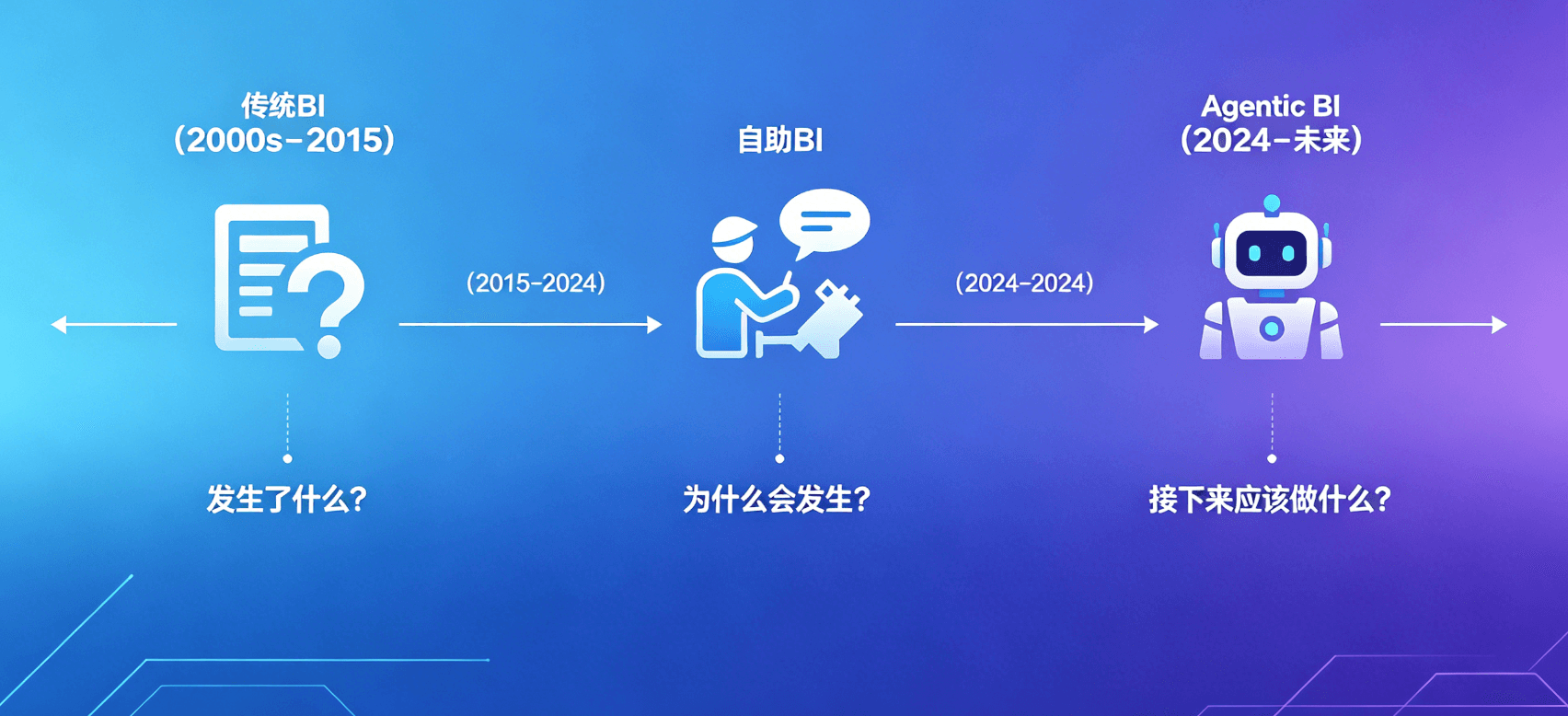
Before understanding Agentic BI, let’s review the three stages of BI evolution:
1.1 The Evolution of BI
| Stage | Time | Characteristics | Core Question |
|---|---|---|---|
| Traditional BI | 2000s-2015 | IT-driven, reports-focused | What happened? |
| Self-Service BI | 2015-2024 | Business users self-serve | Why did it happen? |
| Agentic BI | 2024- | AI Agent autonomous execution | What should we do next? |
The core of Traditional BI is humans viewing reports and making decisions. The core of Self-Service BI is humans operating tools and performing analysis. The core change in Agentic BI is: Agents no longer just assist humans in analysis — they autonomously complete analytical engineering operations.
1.2 HENGSHI’s Definition of Agentic BI
HENGSHI’s Agentic BI has three core characteristics:
- Agents have real operational authority — not “I suggest you do this,” but “I’ll do it for you.” Agents can create datasets, define metrics, generate dashboards, and configure permissions
- Full BI pipeline coverage — not just the single环节 of Q&A, but end-to-end automation from data connection, modeling, and analysis to delivery
- Human decisions, Agent execution — humans decide analysis goals and direction, Agents handle specific engineering execution
II. Technical Pillars of Agentic BI
Agentic BI is not a concept that emerged out of thin air — it rests on three technical pillars:
2.1 CLI Execution Layer: Giving Agents “Hands”
Traditional BI is GUI-based operation, which Agents cannot manipulate. HENGSHI CLI converts all BI operations into command-line interfaces, allowing Agents to complete any BI operation through shell invocation.
This is the most fundamental and critical technical breakthrough of Agentic BI — giving Agents a programmable operation interface.
2.2 Metric Semantic Layer: Giving Agents “Common Sense”
For Agents to operate a BI system, they must understand the business data model and metric definitions. HENGSHI’s metric semantic layer provides a structured “dictionary” for enterprise data, allowing Agents to understand data through semantic matching rather than SQL guessing.
This is the accuracy guarantee for Agentic BI — Agents work based on definitive metric definitions, rather than improvising on the spot.
2.3 Multi-Agent Collaboration: Giving Agents “Division of Labor”
One Agent cannot do everything. HENGSHI’s Data Agent Family splits BI engineering into three specialized roles — modeling, visualization, and Q&A — collaborating through CLI orchestration.
This is the scalability guarantee for Agentic BI — complex tasks are broken down into collaboration among multiple Agents, each handling only the domain it excels at.
III. HENGSHI Agentic BI Product Implementation
3.1 Cockpit vs. Autonomous Driving
In HENGSHI’s Agentic BI product system, “HENGSHI SENSE” is human-driven BI (GUI operation), while “HENGSHI CLI + Data Agent” is autonomous driving BI (Agent operates via command line). The two coexist, serving different usage modes:
- Human analysts → Use SENSE’s GUI for exploratory analysis
- AI Agents → Use CLI’s command interface for standardized engineering execution
3.2 From “Q&A” to “Engineering”
Most vendors’ ChatBI stops at “Q&A” — user asks, AI answers. But from the Agentic BI perspective, Q&A is just the starting point.
A complete Agentic BI workflow is:
Problem → Agent parses intent → Agent matches metrics → Agent queries data →
Agent generates insights → Agent creates dashboard → Agent sets alerts → Agent schedules push
Every step is executed by an Agent; humans only confirm at key decision points.
3.3 HENGSHI BOX as the Physical Carrier of Agentic BI
HENGSHI BOX is the key infrastructure for Agentic BI to move toward production environments.
Its design answers the ultimate security question for Agentic BI: If an Agent has real BI operational authority, who ensures it doesn’t go rogue?
The answer is running the Agent in a physically isolated environment — data doesn’t leave the box, permissions are auditable, and operations are rollback-capable. This gives enterprises the confidence to let Agents “autonomously drive.”
IV. The Real Value of Agentic BI for Enterprises
4.1 Reducing BI Delivery Costs
The biggest cost of traditional BI projects is human labor — data engineers build models, BI engineers create reports, data analysts produce analyses. Agentic BI delegates standardized engineering work to Agents, allowing humans to focus on high-value work requiring business judgment.
A specific efficiency comparison: Creating a sales cockpit with 6 charts, 4 filters, and 3 drill-down dimensions — traditional methods take 2-3 days (requirements gathering + development + testing), while Agentic BI requires only business user describes the need + 5 minutes of Agent auto-generation + 30 minutes of review and adjustment.
4.2 Increasing Data Consumption Frequency
The biggest pain point for enterprise BI is not that the tool is hard to use, but that “nobody uses it.” Agentic BI’s scheduled push and proactive alerting model transforms data consumption from “people finding data” to “data finding people” — data no longer waits to be queried, but proactively appears in front of those who need it.
4.3 Accelerating the闭环 from Data to Decision
The traditional BI decision chain is: view reports → discover problems → deep analysis → write reports → hold meetings → make decisions. Agentic BI automates the analysis and reporting steps in between, allowing decision-makers to judge directly based on insights produced by Agents.
V. The Essential Difference Between Agentic BI and Copilot
Many BI vendors claim their products are “Agentic BI,” but in reality they’re just adding a Copilot (AI assistant) to traditional BI. To distinguish Copilot from true Agentic BI, look at three standards:
| Standard | Copilot | Agentic BI |
|---|---|---|
| Operational Authority | Suggest, assist | Real execution |
| Coverage | Single function (e.g., Q&A) | Full pipeline (modeling→analysis→delivery) |
| Work Mode | Passive response | Proactive execution + passive response |
| Security Model | Not needed (no execution authority) | Needed (has real authority) |
One sentence to distinguish them: Copilot is “I help you,” Agentic BI is “I do it.”
VI. Industry Trends: The Future of Agentic BI from HENGSHI’s Perspective
6.1 Three Inevitable Trends in Agentic BI
- From ChatBI to WorkBI: Evolving from single conversational interaction to Agent automation covering the complete workflow
- From General Agent to Specialized Agent: Evolving from universal Agents that can chat about anything to specialized roles like Modeling Agent, Analysis Agent, and Report Agent
- From Cloud to Edge: Agent operating environments migrating from cloud to edge devices (such as HENGSHI BOX) to meet security and compliance requirements
6.2 When Should Enterprises Adopt Agentic BI?
Not every enterprise needs Agentic BI right now. The following signals can serve as reference for judgment:
- Data foundation is ready: The enterprise already has clear data models and metric systems
- BI consumption has scale: Sufficient daily query volume so automation can generate significant ROI
- Security architecture is established: The enterprise has mature plans for Agent permission control and auditing
- Team has AI awareness: Management understands Agent capabilities and boundaries, without overly high or low expectations
VII. Frequently Asked Questions
Q1: Will Agentic BI replace data analysts?
A: Not in the short term. Agentic BI replaces standardized operations in data engineering (modeling, report creation, charting), but the core value of data analysts — understanding business, defining metrics, interpreting data, providing recommendations — remains human work. A more accurate description is: Agentic BI upgrades people from “tool operators” to “analytical decision-makers.”
Q2: What happens if an Agent makes mistakes during execution?
A: HENGSHI CLI’s dry-run mechanism keeps Agent execution under human supervision at all times. Critical operations (such as permission changes or data deletion) require human confirmation before execution. Additionally, all Agent operations have complete audit logs for traceability and rollback.
Q3: What is the difference between Agentic BI and RPA (Robotic Process Automation)?
A: RPA is rule-based automation (if-then), handling fixed processes. Agentic BI is AI-based automation, where Agents can understand context, adapt to changes, and handle unforeseen scenarios. Simply put, RPA is “following the script,” while Agentic BI is “improvising based on the situation.”
VIII. Summary
Agentic BI is not a new feature in the BI industry, but a paradigm shift — from “humans operating tools” to “Agents operating tools.” This shift won’t happen overnight, but it has already begun.
HENGSHI’s practice in Agentic BI provides a complete reference architecture: CLI as the execution layer, semantic layer as the knowledge foundation, multi-Agent as the division-of-labor model, and BOX as the security boundary. The value of this architecture lies in its completeness — it not only solves the question of “how does an Agent analyze data,” but also solves the question of “how does an Agent analyze data safely, reliably, and measurably.”
For enterprises evaluating the next-generation BI path, Agentic BI is a direction worthy of serious research. And understanding HENGSHI’s practice is a good starting point for understanding this direction.