
Article body
Full article
Abstract: Businesses want AI analysis to help people move from a question to evidence-based findings faster, then reuse the results in dashboards, meetings, and business applications. HENGSHI SENSE connects data preparation, metric management, Data Agent, and visual authoring, while HENGSHI CLI provides an execution entry point for scripts and external agents. Starting with a regional sales analysis, this article explains how these capabilities form a reusable task path and how people and systems should share responsibility for ongoing operation.
1. Turn proactive analysis into everyday tasks
A sales leader might ask, “Why did East China sales fall short of expectations this month?” Answering usually requires agreeing on the sales definition, checking data freshness, comparing targets with actuals, and breaking the results down by region, channel, or category. Analysts must also prepare charts, explain changes, and put the material where the business team actually uses it. Delays often occur at the handoffs between these steps.
The value of Agentic BI can be understood through reducing these handoff costs. Business users describe their analytical objectives directly; Data Agent finds and queries data within the accessible scope and assists with metrics and visualizations; confirmed results become assets that can be used again. This gives businesses a more natural way to ask questions and extends a conversation into an analytical task.
Three triggers need to be distinguished: an ad hoc business question, scheduled delivery of recurring material, and an investigation initiated when alert conditions are met. They can share data and metrics, but their trigger mechanisms differ. Conversational analysis, scheduled subscriptions, and data alerts have their own product entry points. How cross-system events trigger an agent, and who approves business actions, must be designed explicitly in the integration workflow.
2. Connect business language through shared data and metrics
In a regional sales task, “sales” might mean order value, payments received, or net sales after refunds. “This month” might mean a calendar month or the company’s financial period. Without agreed meanings, even a rich set of charts can answer the wrong question.
HENGSHI’s data integration capabilities extract, filter, transform, join, and aggregate data from multiple sources to prepare it for analysis. Metric management organizes metrics by business topic and supports taking them online or offline and authorizing their use. Implementation teams can place net sales, sales targets, and target attainment in the same business topic, with clear owners and scope, so multiple analytical entry points use the same definitions.
Data Agent can also use industry prompts, dataset knowledge, and field descriptions to understand company terminology. Maintaining fiscal-year rules, order statuses, and special filters in the appropriate places is easier than explaining them afresh in every conversation. Data vectorization helps semantic retrieval locate relevant objects; metric definitions and access permissions remain governed by business rules and permission settings respectively.
| What the analytical task needs | HENGSHI capabilities | Reusable output |
|---|---|---|
| Analyze data from multiple systems together | Data connections, integration processing, and dataset modeling | Datasets with confirmed granularity and relationships |
| Give a business term a consistent meaning | Metric definitions, business topics, and knowledge management | Maintainable definitions and business explanations |
| Break a question into queries and comparisons | Data Agent intent understanding, complex-question decomposition, and data queries | Checked results and follow-up questions |
| Put findings in a form that can be used again | Assisted chart, dashboard, and metric authoring, plus intelligent interpretation | Editable, reusable analytical assets |
| Deliver results to their users | Application publishing, subscriptions, and embedding | Content suited to the intended roles and channels |
3. Turn broad questions into an executable analytical scope
HENGSHI Data Agent can decompose a request according to user intent and run one or more data queries depending on its complexity. On a data package, dataset, or dashboard page, it can also work with the current page context. This helps refine “sales have been weak lately” into analysis of trends, comparisons, and structural changes.
Effective collaboration starts by agreeing on the analytical conditions. If the current month is incomplete, specify whether to compare complete calendar months or the same number of elapsed days. If targets are maintained monthly, do not divide a single day’s actuals by a monthly target directly. If inventory, marketing, or competitor information is unavailable, first describe the changes in sales composition and list external explanations as items to investigate.
The following business-question example expresses task constraints and delivery requirements. It is not a set of HENGSHI API parameters and does not guarantee that the model will execute in exactly the same order every time.
Scope: Authorized sales business topic; September 2026; East China.
Metric definitions: Use the topic's confirmed definitions of net sales and target attainment.
Comparison: Compare with August 2026 and explain the difference in month length.
Analysis: Start with the total, then compare changes by province, channel, and category.
Evidence: Retain the reporting period, filters, and data supporting each finding.
Delivery: Produce a trend chart, a structural comparison, and a business commentary.
Missing evidence: List information to investigate; do not infer external facts that are not connected.
This approach preserves familiar business language while setting clear analytical boundaries. When expanding the region, adding comparison metrics, or changing the period, make the change explicit before continuing, so definitions do not drift unnoticed.
4. Bring conversational results into editable analytical assets
Returning a number is only part of the task. HENGSHI Data Agent can assist with creating a dashboard from scratch or adding charts, filters, and rich text to an existing dashboard and adjusting its layout. Analysts can therefore continue improving assets in their existing applications and reduce the work of manually rebuilding conversational results as charts.
For example, after confirming a sales decline in a province, a business leader can ask, “Add a channel comparison for this province and place an explanation beside the chart.” The team should check that chart periods, filters, sorting, and units match the text before including the content in formal business material. Intelligent interpretation helps query, summarize, and describe existing data; confirming business causes still requires supporting evidence.
For teams already using scripts, CI, or external agents, HENGSHI CLI exposes platform capabilities such as queries, dashboard and element configuration, and authorization as callable commands. Official skills further explain execution order and result reporting. The following commands only show a starting point for reading context; replace the example application ID with an actual object in your instance.
hbi auth status --output json
hbi app list --area personal-area --root --output json
hbi dataset list --app 4812 --output json
Before writing, check whether the target already exists and use the preview capabilities supported by the current command. For operations such as authorization, inspect the --dry-run result first. Explicit task authorization and workflow rules should determine whether to execute after the preview and how to accept the result. After the CLI changes resources, return to the target page to check the charts and layout.
5. Combine product capabilities with organizational responsibilities
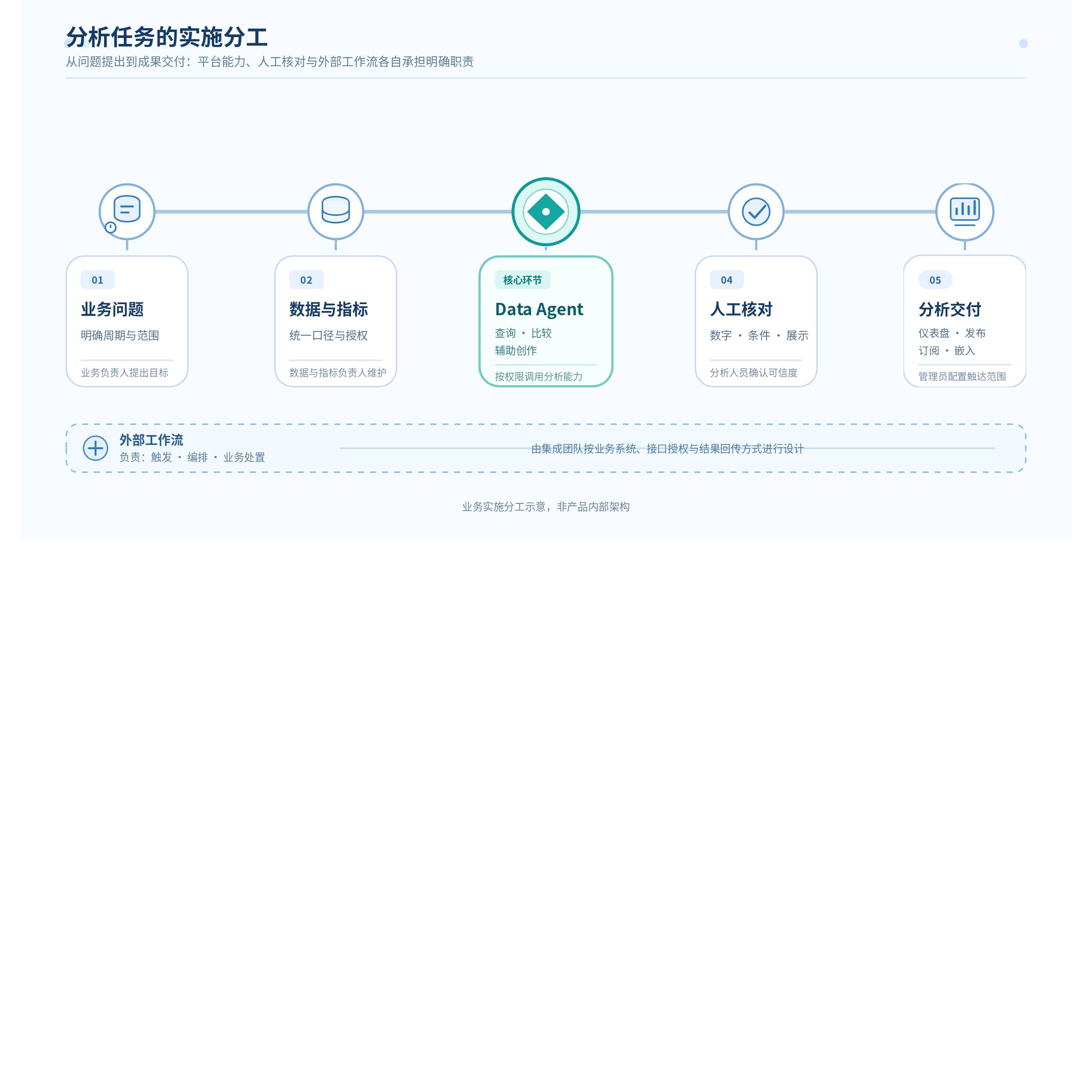
If a business wants analysis using the same definitions every week, it must assign responsibility for triggering, data updates, analysis, confirmation, and distribution. Scheduled subscriptions suit recurring dashboard delivery, data alerts suit reminders based on configured conditions, and Data Agent suits investigation and authoring. These capabilities can be combined, but successful notification and resolution of a business problem are different acceptance outcomes.
| Stage of ongoing analysis | Responsibility | Implementation ownership to clarify |
|---|---|---|
| Prepare data and metrics | Data updates, granularity, topics, and metric definitions | Data owners maintain availability and definitions |
| Analyze and author assets | Data Agent queries, interpretation, and visualization assistance | Analysts check numbers and presentation |
| Schedule distribution or conditional reminders | Subscriptions, data alerts, and channel configuration | Administrators confirm schedules, recipients, and information scope |
| Take action in other business systems | External workflows, tickets, or business-system execution | Integration teams define interfaces, authorization, and result reporting |
| Review and maintain methods | Task requirements, validated practices, and exception handling | Business and technical teams jointly review and version the methods |
When companies want to make their working methods available to a persistent agent, the HENGSHI JARVIS consulting and enablement offering can establish an operational foundation around structured knowledge, task routing, and workflows. It has a different role from SENSE’s analytical capabilities and the CLI’s execution entry point. How specific business tasks are orchestrated and which external systems are connected must still be determined during implementation.
6. Validate practical value through recurring tasks
A company can start with a weekly business-analysis task whose definitions are clear and compare manual preparation with collaborative analysis: How long does it take to reach a reviewable result? Are teams still repeatedly explaining the same metric? Can generated charts go directly into existing applications? Are handoffs clear when permissions are restricted or data is missing? These are project acceptance dimensions, not preset platform performance commitments.
HENGSHI Agentic BI provides a continuous analytical path: connect business language to governed data, use Data Agent to advance queries and authoring, and retain the results in analytical assets that people actually use. When task requirements, product capabilities, and delivery responsibilities align, analysis can keep pace with business change and be reused across the team.