
Article body
Full article
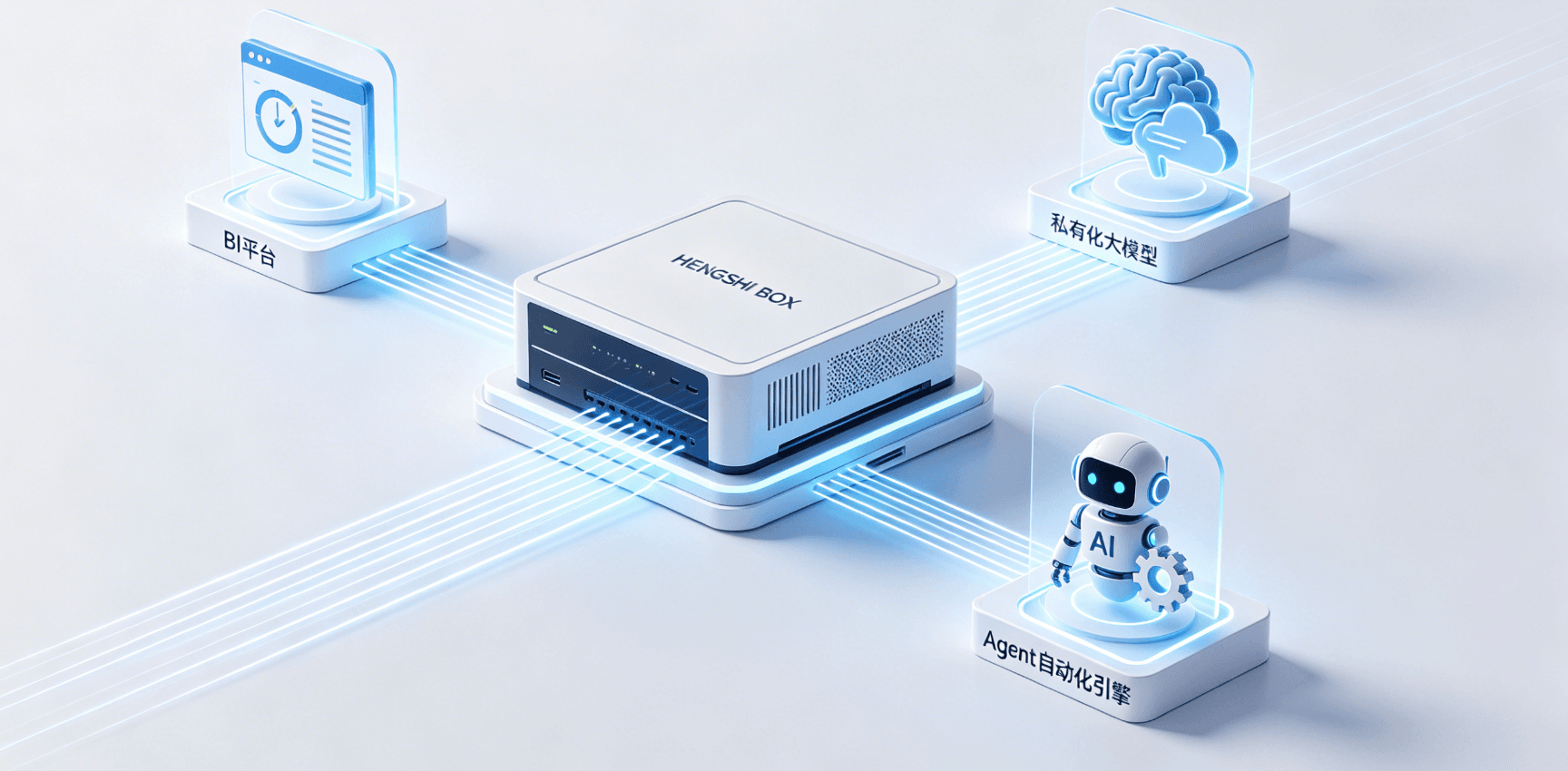
Summary: HENGSHI BOX is a software-hardware integrated ChatBI intelligent analytics appliance jointly created by Hengshi Technology and xFusion, deeply encapsulating a BI platform, privately deployed LLM, and Agent automation engine into one physical device. This article helps enterprise decision-makers evaluate whether HENGSHI BOX suits their data intelligence needs from five dimensions: product definition, core advantages, application scenarios, version selection, and deployment considerations.
1. Understanding HENGSHI BOX: The Logic Behind Software-Hardware Integration
In the process of enterprise AI implementation, there has always been a dilemma: using public cloud LLMs raises data security concerns, while deploying privately operated models faces high engineering costs.
HENGSHI BOX’s design logic is the answer to this dilemma: package BI analytics capabilities, LLM inference capabilities, and Agent automation capabilities into one physical device, giving enterprises a complete AI analytics infrastructure within their own data centers.
It’s not an ordinary server, nor is it a simple hardware packaging of software. Its design出发点 (design philosophy) is:
- Security is a hard constraint, not optional — For industries like finance, healthcare, and government, data not leaving the physical boundary is a basic requirement
- Lower total cost of AI ownership — Converting unpredictable Token consumption into depreciable fixed assets
- Shorten time from deployment to output — Plug and play, no complex hardware/software selection, integration, and debugging needed
2. Four Core Advantages In-Depth Analysis
Advantage 1: Agentic BI Autopilot
This is HENGSHI BOX’s most core differentiating capability.
Traditional BI projects require a long cycle of “requirements research → data modeling → report development → testing and launch.” HENGSHI BOX’s built-in HENGSHI CLI terminal execution layer gives the Agent real operational permissions—
- Automatic data connection: The Agent automatically detects data source Schema and establishes field mappings
- Automatic metric modeling: Automatically completes model building and metric definition based on business semantics
- Automatic dashboard generation: After receiving natural language instructions, automatically lays out and generates a complete dashboard
Taking a typical scenario as an example: A business head says “Help me create an East China regional sales dashboard, connecting orders, inventory, and customer datasets.” The Agent will automatically complete Schema detection, relationship modeling, and dashboard generation, outputting a complete cockpit with charts, filters, and drill-down dimensions.
Key understanding: This “autopilot” is not simple Chat-to-Chart—it means the Agent has the same operational permissions as a BI engineer, able to create, modify, and delete BI assets. This upgrades HENGSHI BOX from a “Q&A tool” to an “engineering tool.”
Advantage 2: Physical-Level Data Security
Among all security levels, physical isolation is the highest. HENGSHI BOX achieves—
- Natural language processing local closed loop: Users’ natural language questions never leave the device
- LLM inference local closed loop: All model inference completes on the GPU/CPU built into BOX
- Data computation local closed loop: Dataset queries, metric calculations, and chart rendering all execute entirely within the device
- Core data never leaves the chassis: Fundamentally preventing the risk of data flowing to external model services via API
For enterprises needing to meet compliance standards like 等保, GDPR, and industry regulations, physical-level isolation is the strongest guarantee for compliance.
Advantage 3: Token Free, Budget Friendly
The public cloud LLM business model is Token-based billing, which means continuous and unpredictable costs for high-frequency BI scenarios. HENGSHI BOX’s solution is—
- Built-in BI scenario quantized and fine-tuned local model: Specifically optimized for BI high-frequency tasks like SQL translation, metric interpretation, and data insights
- High-frequency operations with zero API consumption: Enterprises’ daily data Q&A and metric queries incur no external API call fees
- Converting variable costs to fixed costs: One-time equipment purchase with no additional computing power fees for subsequent use
For enterprises with high daily query volumes (such as retail chains, financial institutions needing high-frequency data consumption), the Token Free model’s cost advantage becomes increasingly significant over time.
Advantage 4: Plug and Play
HENGSHI BOX comes pre-installed with a full-stack environment, including out of the box—
- HENGSHI SENSE Intelligent Analytics Platform (BI core engine)
- HENGSHI CLI Agent Terminal Execution Layer
- Vector Database (supporting RAG semantic retrieval)
- Agent Skills Suite (pre-built Agent capability packages)
- Local LLM (BI scenario fine-tuned version)
- Agent Automation Engine
Enterprises only need to connect power and network to start using it. No separate purchase of servers, GPUs, databases, vector databases, etc., and no complex environment configuration and commissioning needed.
3. Three Typical Scenarios: From BI Engineering to Intelligent Data Querying
Scenario 1: BI Engineering, Automatically Built
Traditional pain point: Facing massive heterogeneous data, implementation teams need several days or even weeks to complete one analytics scenario setup.
BOX capability: After the Agent receives instructions, it automatically completes the full chain of Schema detection, relationship model establishment, and dashboard generation via HENGSHI CLI.
Value quantification: Compresses what originally took several days into minutes, greatly reducing BI project delivery costs and dependence on specialized personnel.
Scenario 2: Analysis Reports, Scheduled Push
Traditional pain point: Management waits weekly for reports, IT department rushes reports monthly—a typical “people looking for data” mode.
BOX capability: A resident Agent continuously monitors business metric fluctuations, automatically generates illustrated analysis briefs according to preset logic, and precisely pushes them to work terminals like DingTalk and WeChat Work.
Typical workflow:
- Agent automatically pushes daily business briefs (sales, MoM, inventory turnover, and other core metrics)
- Proactively alerts when anomalies occur (e.g., “South China inventory turnover down 15%, recommend paying attention to channel inventory risk”)
- Supports receiving follow-up questions for deep analysis (e.g., “Which city in South China had the largest decline?”)
Scenario 3: Intelligent Data Querying, On-Demand
Traditional pain point: Business users wanting to see data need to submit requirements to data analysts, wait for scheduling, wait for report generation—the entire process takes days.
BOX capability: Business users ask questions instantly via natural language; the local model drives the Agent to instantly complete complex metric calculations and visualization.
Key guarantee: Based on a unified metrics semantic layer, ensuring different people asking the same question get the same answer.
4. Version Selection: Professional vs Enterprise
HENGSHI BOX provides two versions, covering different needs from department-level applications to group-level deployment.
| Comparison Dimension | Professional | Enterprise |
|---|---|---|
| Device Form Factor | Silent desktop/small rack-mount | 2U/4U standard rack-mount server |
| Business Load | Daily conversation, metric queries, single-line Agent tasks | Complex logic reasoning, high-concurrency Agent group collaboration |
| Applicable Scale | Department-level (10-50 users) | Group-level (50+ users, multi-department concurrency) |
| Typical Scenarios | Startup team data analytics, business department self-service analytics, POC verification | Full-group BI platform, high-frequency concurrent decision-making, large-scale analytics jobs |
| Deployment Environment | Office environment, no dedicated server room needed | Standard data center server room deployment |
Selection Recommendations
- First-time trial, limited budget: Choose Professional. Start from one small team or business scenario, then expand after validating value
- Already have clear multi-department concurrent needs: Choose Enterprise. Enterprise version has more computing power and stability for high-concurrency scenarios
- POC verification stage: Professional. Fast launch, fast validation, fast results
- Extremely high data security requirements but small user base: Professional fully meets physical isolation requirements; no need to force an upgrade to Enterprise for security reasons
5. Deployment Considerations: Who Is HENGSHI BOX For?
HENGSHI BOX is not a universal solution for “all enterprises”—its value is most prominent in the following scenarios:
Highly Aligned Scenarios
- Finance, Insurance, Securities — High data compliance requirements; data exiting the country or going to the cloud is restricted
- Healthcare — Patient data and diagnosis/treatment data under strict privacy protection
- Government and State-Owned Enterprises — Driven by compliance requirements and Xinchuang (domestic tech) policies
- Large-Scale Manufacturing — Workshop data and analytics capabilities need on-premises deployment
- Enterprises with overseas compliance needs — Avoiding compliance risks of cross-border data transmission
Scenarios Requiring Consideration
- Pure internet/SaaS companies — If data is already on the cloud without compliance concerns, cloud deployment may be more flexible
- Small teams (<10 people) — Can start with Hengshi SaaS or cloud deployment, evaluate BOX later
- Already have mature private GPU clusters — May need to evaluate whether to purchase BOX or reuse existing infrastructure
Key Decision Checklist
When evaluating HENGSHI BOX, enterprises are recommended to confirm the following checklist item by item:
- Does business data require physical isolation? (Yes → BOX priority increases)
- What’s the estimated daily ChatBI query volume? (Large → BOX’s Token Free advantage is significant)
- Is there an existing operations team managing data center equipment? (Yes → Enterprise; No → Professional is more friendly)
- Is multi-department multi-tenant isolation needed? (Needed → Enterprise)
- Need to see ROI within 3 months? (Yes → Professional, fast launch and validation)
6. FAQ
Q1: What’s the difference between HENGSHI BOX and buying a server and deploying Hengshi + open-source LLMs on your own?
A: Four dimensions of differences are worth noting. First, integration cost—BOX comes pre-installed with a full suite of tuned and adapted software; self-deployment requires one-by-one commissioning of BI platform installation, LLM deployment, vector database configuration, Agent engine setup, etc. Second, model quality—the model built into BOX is quantized and fine-tuned for BI scenarios (SQL translation, metric interpretation, data insights); general-purpose open-source models require self-validation and tuning for these scenarios. Third, maintenance cost—BOX is a unified product provided and maintained by Hengshi; self-built solutions require enterprises themselves or third parties to continuously invest in maintenance. Fourth, hardware compatibility and stability—BOX’s software and hardware are jointly verified; self-built solutions need to solve compatibility issues independently.
Q2: What exactly is Token Free? Which operations don’t consume Tokens?
A: Token Free means HENGSHI BOX’s built-in local model doesn’t call any external APIs when processing BI scenario high-frequency operations, so no Token billing occurs. Coverage includes SQL translation (NL2SQL), metric semantic matching, data insight generation, and other daily analytics operations. If enterprises need to access stronger external general-purpose LLMs for more complex tasks (such as long-form report writing), BOX also supports connecting to external APIs, and this portion will incur corresponding API fees.
Q3: How capable is the model built into BOX? Can it compare to GPT-4 or Claude?
A: This is comparing different types of things. The model built into BOX is a model specifically fine-tuned for BI scenarios, directionally optimized for vertical tasks like SQL generation, metric matching, and data interpretation. It doesn’t pursue general-purpose conversational and long-text creation capabilities (for these scenarios, enterprises can additionally connect to general-purpose LLMs), but rather pursues stability and cost-effectiveness on BI high-frequency tasks. General-purpose LLMs are like “general practitioners,” while the model built into BOX is like a “specialist.”
Q4: Does BOX support connecting to external LLMs?
A: Yes. HENGSHI BOX’s architecture supports connecting to external general-purpose LLM services, which enterprises can flexibly configure based on their needs. Daily high-frequency BI operations use the local model (Token Free); more complex tasks requiring stronger reasoning can be routed to external models. This “local + cloud” hybrid deployment mode balances cost and security.
Q5: If I buy Professional first, can I upgrade to Enterprise later?
A: It is recommended to directly consult Hengshi sales for the latest upgrade policy. There are typically two paths: hardware expansion (in some scenarios, computing power modules can be added to Professional) or replacement upgrade (Professional offsets part of Enterprise costs).
Q6: What’s the relationship between HENGSHI BOX and Hengshi Data Agent? Do I need to buy both?
A: HENGSHI BOX is the deployment form (hardware appliance), while Data Agent is the capability module (AI analytics intelligent agent). BOX already includes Data Agent’s capabilities internally. Choosing BOX means choosing the complete solution of “hardware device + full software suite + AI capabilities.” If your enterprise doesn’t need physical isolation, you can also choose to separately deploy the Hengshi platform on the cloud or your own servers and enable Data Agent capabilities.
7. Summary
The core problem HENGSHI BOX solves is not “Can AI analyze data,” but “How to get AI into enterprises’ daily work workflows safely and controllably.”
Its design philosophy can be summarized in one sentence: Let AI enter the enterprise’s physical boundary, rather than letting the enterprise’s data flow toward AI. This directional choice determines its irreplaceable value in industries with high compliance requirements like finance, healthcare, and government.
For enterprises evaluating “whether to adopt AI BI,” HENGSHI BOX provides a unique third path—not public cloud AI, not self-built open-source solutions, but a plug-and-play, securely closed-loop intelligent analytics appliance.