
Article body
Full article
Abstract: Enterprises can already use AI agents to read code, organize documents, call tools, and produce analysis. Bringing those actions into everyday work still requires reliable context, clear execution boundaries, and verifiable delivery evidence. HENGSHI JARVIS is HENGSHI’s consulting and enablement offering for software companies. It helps teams build an operational foundation for AI agents through knowledge indexes, workflows, skills, and continuous feedback. By connecting enterprise knowledge with actual tasks, it enables different agents to follow shared rules and turns verified experience into organizational assets. This article explains how JARVIS works and where its boundaries lie, covering knowledge organization, task execution, quality governance, and implementation delivery.
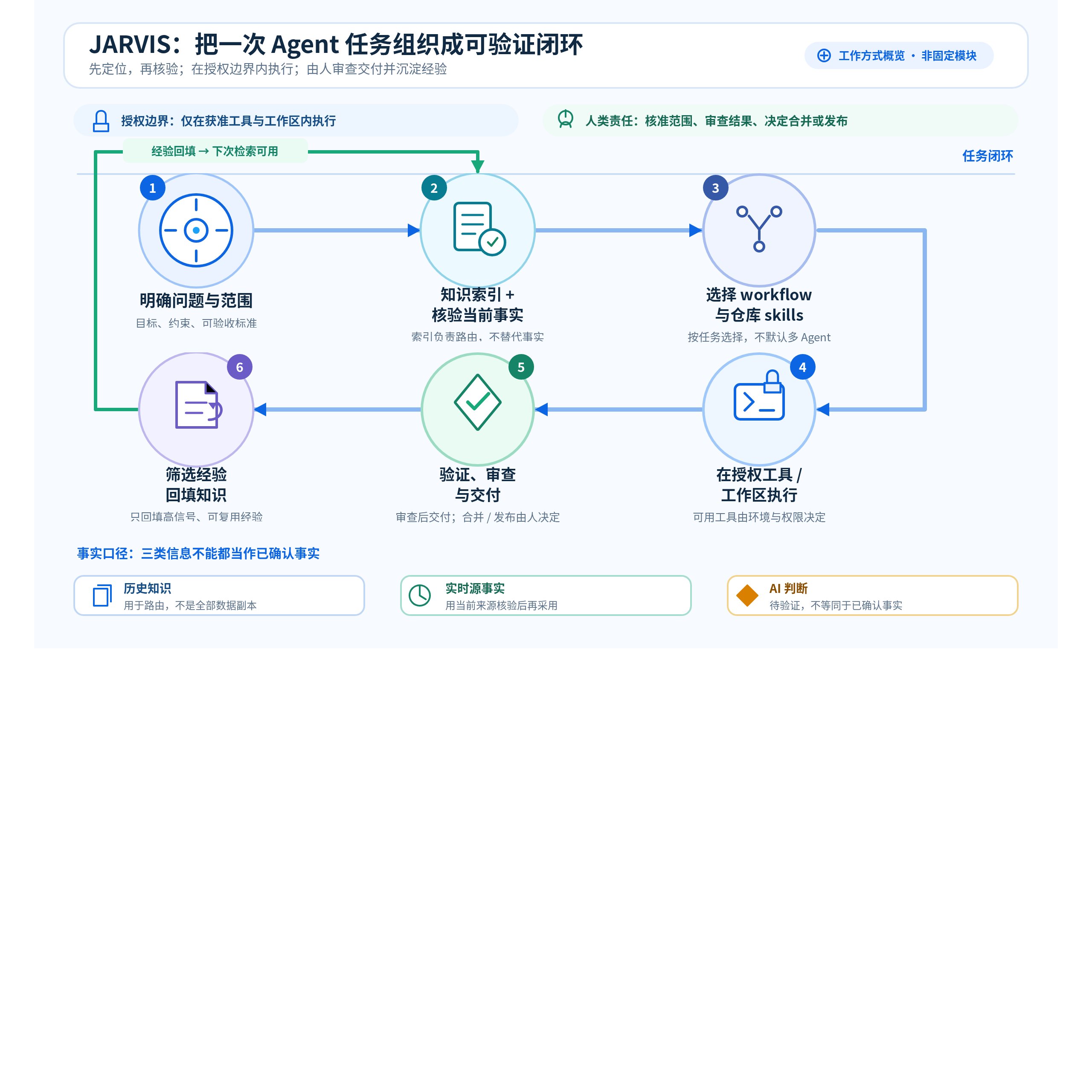
Figure: JARVIS organizes an agent task into a verifiable cycle of locating sources, checking evidence, executing, reviewing, and capturing knowledge. People retain responsibility for scope, review, and publication decisions.
1 What an Enterprise Needs to Prepare for Agents
A successful demonstration often takes place with a clear problem, complete data, and available tools. Real enterprise tasks have different conditions: requests may arrive through scattered conversations, products carry compatibility constraints, code spans repositories, business data has access restrictions, and test environments differ from production. Even an agent that produces a fluent explanation can choose the wrong execution entry point, reuse outdated facts, or mistake a local check for complete delivery.
JARVIS focuses on three questions: how knowledge is found, how work progresses, and how results are judged. When knowledge is scattered, agents repeatedly read documents and code and may miss historical decisions. When processes are scattered, team members maintain separate prompts without consistent handoff standards. When feedback is scattered, teams see generated results but struggle to trace validation, review, and subsequent use. Addressing these problems requires designing knowledge ownership, execution tools, and acceptance responsibilities together.
JARVIS’s core value is organizing an enterprise’s existing knowledge and engineering methods into a working system that agents can execute and teams can review. Models provide understanding and reasoning, tools provide queries and operations, and enterprise rules specify what is allowed, where work should happen, and how completion must be demonstrated. Together, these conditions determine whether an agent can take on a task; neither model capability nor prompt length can replace them.
2 Knowledge Indexes: Find the Basis, Then Check the Current State
Organize Knowledge by Module, Source, and Relationship
A useful knowledge foundation tells agents which module owns a business capability, where current entry points are, which constraints must be preserved, and which historical problems deserve attention. HENGSHI maintains module overviews, known issues, design decisions, and test coverage separately. Cross-module topics record dependencies and interactions, while source entry points link to product documentation, repositories, work items, and other authoritative systems. Agents can follow task clues to the relevant modules and then drill down into evidence as needed.
For example, a dashboard filtering problem may involve page state, query parameters, permissions, and backend computation. Module knowledge helps an agent locate these related areas and examine similar past problems. Whether the current case is actually the same historical defect still requires checking the input, runtime results, and version facts. Known issues reduce blind searching and provide leads; similar keywords alone do not justify applying an old fix.
Knowledge indexes primarily hold stable rules and source pointers; the original systems confirm live state. Copying every document, ticket, and log into a long-lived snapshot creates inconsistent updates. A more dependable approach identifies each knowledge domain, its maintenance owner, and its evidence links, then reads current documents, work items, code, and validation records during task execution. Teams can accumulate experience while checking whether facts have changed before consequential operations.
History, Present, and Future Serve Different Purposes
JARVIS’s temporal organization describes three information roles. History records confirmed product knowledge, including design choices, problem patterns, rejected requests, and their rationale. Present covers facts that must be checked for the current task, such as work-item status, target version, actual code, environment, and owners. Future contains candidate judgments derived from the first two, such as whether a request is a duplicate, where a problem may originate, and which modules a change may affect.
These distinctions matter. Historical decisions may not apply to a new version; current snapshots need timestamps and sources; AI inferences need reproduction, source tracing, or business confirmation before they become evidence. Scheduling and complexity estimates should retain assumptions and uncertainty. Inclusion in a knowledge system does not turn them into committed delivery plans. Only verified information with reuse value should enter durable knowledge after a task ends.
3 Workflows and Skills: Connect Judgment to Execution
Identify the Task Before Choosing the Method
Enterprise tasks include product defects, feature requests, documentation updates, release notes, knowledge governance, business analysis, and recurring reports. JARVIS first identifies the cycle to complete, then selects the workflow and tools. For engineering work, user-supplied documents, errors, screenshots, or work items form the starting point. Agents must read the original material, establish the user goal, observed behavior, and known constraints, and then choose where to obtain the first evidence.
Routing changes with the evidence. A reported “system error” may be a permission setting, existing product behavior, a duplicate problem, or a genuine code defect. Missing evidence should be identified explicitly. A feature request needs an implementable scope before development. A confirmed defect proceeds to diagnosis, modification, and validation. Workflows organize these decisions rather than sending every input directly into the same coding step.
Workflows Define the Cycle; Repository Skills Define the Method
A workflow describes the necessary steps from input to delivery for a class of task. Repository-local skills govern execution within a particular repository. Frontend, backend, documentation, and test repositories have different architectures, commands, and validation entry points; agents must follow the local rules after entering them. Work across repositories also needs to distinguish the capability owner, the interfaces and tools that deliver it, and the documentation and tests that must follow. This prevents a local edit in the easiest file from missing the module that actually owns the semantics.
Parallel collaboration can support independent research, implementation, or review, provided each participant has a defined responsibility, input, shared state, and evidence to return. Multiple agents should not edit the same code simultaneously, and a subtask report alone cannot establish completion of the whole task. The main task must integrate results, examine dependencies and conflicts, and check consistency across delivery surfaces. Parallelism, runtimes, and tool integrations should be chosen according to task risk and the customer’s environment.
Workflows and skills can become reviewable text, repository rules, and tool-call conventions. Projects that need visual orchestration, automatic scheduling, or a dedicated test platform can integrate those systems within the agreed scope. These integrations require configuration and acceptance; a consulting framework’s capability directions do not mean every project automatically includes the same ready-made features.
4 Five Dimensions, Grounded in Verifiable Engineering Actions
Cognition, orchestration, delivery, governance, and feedback provide five perspectives for building JARVIS. Their usefulness comes from the actions and evidence attached to each dimension. Knowledge must have traceable sources, orchestration must support handoffs, delivery must be reproducible, governance must define permissions and responsibilities, and feedback must update verified experience.
| Dimension | Work to establish | Verifiable result |
|---|---|---|
| Cognition | Organize modules, decisions, known issues, and source entry points | Tasks can find a basis and check its applicability |
| Orchestration | Define routing, execution order, and collaboration responsibilities | Inputs, scope, handoff conditions, and next steps are clear |
| Delivery | Reproduce or check the problem, make changes, and validate them | Others can inspect results and access delivery links |
| Governance | Configure permissions, reviews, environments, and tool boundaries | Execution is authorized and changes have owners and review evidence |
| Feedback | Analyze usage feedback, select reusable experience, and update knowledge | Updates are verified and reusable in later tasks |
Quality Gates Must Check the Behavior That Actually Changed
HENGSHI’s engineering rules require checking assumptions and scope, making the smallest necessary change, validating it, and delivering reviewable results. Defect validation must cover the original trigger or explain an equivalent scenario. Feature validation must cover defined acceptance rules. Documentation checks must examine facts, structure, and references. Interface changes also require inspecting actual rendering and interaction. Validation must expose errors the current change could cause; unrelated checks cannot substantiate completion.
Tests are engineering assets whose reuse, adjustment, or addition must be assessed. Some defects require real regression cases, while low-risk copy changes may be verified by focused readback. Generated cases still need scrutiny: do their inputs reflect realistic scenarios, and do their assertions match business requirements? Security scans, efficiency dashboards, and release monitoring may be included in a customer’s scope, but they require actual tools, data, and responsible owners. Framework names do not establish complete coverage of security or business risk.
Reviewable delivery evidence is a completion condition for agent work. Code changes need the appropriate review entry point, version, and validation results. Documents need accessible content or links. Analysis reports need clear definitions, data scope, and supporting results. A locally generated file, finished code, or one successful test does not automatically replace a deliverable the user can access and accept. Merging, deployment, and consequential business actions continue to follow the enterprise’s existing authorization and responsibility arrangements.
5 Understanding the Cycle Through a Repair
Consider an abnormal metric on a dashboard. JARVIS’s method can be understood through six actions. First, read the user’s material and check filters, metric definitions, expected results, and actual results. Second, locate the relevant modules, known issues, and current data to distinguish a definition, permission, configuration, or computation problem. Third, establish the change scope and choose the correct repository skills and execution entry points.
During repair, the agent traces the actual data and state sources, corrects the behavior with the smallest explanatory change, validates the original conditions, and checks affected neighboring uses. Code requiring remote review needs a reviewable change request and validation notes. Changes to product usage also require documentation and test follow-through. Delivery states what was fixed, which version was validated, and what limitations remain, enabling maintainers to take over.
Finally, the team decides whether knowledge should be updated. A stable error pattern may belong in known issues; a changed product contract may require a design decision; an isolated environment configuration mistake may need only a task record. Putting every conversation or diagnostic log into shared knowledge adds noise and may disclose accounts, paths, or customer information. Continuous improvement requires selection, verification, and appropriate sanitization.
This example also shows that a JARVIS cycle does not automatically merge or publish. It places required evidence and next-step ownership into execution, allowing agents to take on more work with clear boundaries while product, engineering, testing, and operations retain their review responsibilities.
6 From a Pilot to Organizational Capability
Expand According to Acceptance Results
Implementation can progress through foundation, expansion, and governance. The foundation stage selects a domain with reasonably complete knowledge and clear owners, organizes modules and sources, connects necessary tools, and completes one or two representative task flows. Expansion addresses cross-repository delivery, documentation and test coordination, and repeatable workflows. Governance gradually establishes quality reviews, efficiency analysis, and knowledge maintenance. Each stage needs actual tasks that can be revisited as acceptance evidence.
Timelines depend on code and knowledge scale, access readiness, test environments, data availability, and collaboration patterns. Fixed week counts should not become universal promises. Nor should team headcount determine eligibility: teams with many modules, historical constraints, and frequent collaboration tend to encounter these problems more often, but small teams can begin with a lightweight index and one workflow, expanding according to usage.
Agree on Deliverables and Maintenance Responsibilities Together
Depending on scope, a project may deliver a knowledge structure and source routes, module knowledge, repository skills, representative workflows, tool integration instructions, acceptance examples, an ownership map, and maintenance practices. Acceptance should check whether real requests lead to the correct sources, skills fit existing tools, changes have validation paths, key permissions are controlled, and team members can maintain the assets independently. Customers have different toolchains and domains, so the final list belongs in the agreed solution and acceptance criteria.
Knowledge needs ongoing ownership. Product owners confirm requirements and contracts; engineering owners maintain architecture and execution rules; test owners assess realistic scenarios and regression value; business and operations staff provide usage results and runtime feedback. Agents can organize information, compare it, and propose updates, but changes to durable rules need evidence. This allows the knowledge foundation to evolve with the business instead of becoming outdated after initial delivery.
Observe Value Through Task Outcomes
Efficiency assessment should start with a pilot baseline: does requirement clarification reduce rework, is diagnosis faster, are review conclusions easier to reproduce, does documentation follow promptly, and do repeated problems decrease? Record failures, reopened problems, and reasons for human takeover as well. Generated lines of code, call counts, and runtime durations describe only part of the activity and cannot independently prove business value. Before-and-after comparisons also require comparable task types, difficulty, and validation requirements.
7 How JARVIS Works with Other HENGSHI Capabilities
JARVIS focuses on enterprise knowledge, execution methods, and collaboration governance. HENGSHI CLI provides BI engineering tools for agents. Its current command entry point is hbi, covering data integration, HQL queries, dashboard generation, permissions, and operations, with structured output and supporting skills. JARVIS can define task understanding, execution, and acceptance, while the CLI performs specific BI operations within authorized boundaries. Some commands support change previews, and results can be reviewed by people. These engineering interfaces already exist and should not be described as future plans.
AI analytics agents address BI scenarios such as data questions, analysis, and creation, connecting natural language with controlled data assets. HENGSHI BOX is a private analytics delivery solution combining hardware and software: the HENGSHI analytics platform, local models, and agent automation. It should not be reduced to a hardware box for a generic agent. These capabilities can work with JARVIS, but each has its own positioning, integration prerequisites, and delivery scope.
Using JARVIS’s knowledge and workflow methods does not require every task to enter a BI platform. Analytics and BI engineering tools can be combined when needed. The models, agents, business systems, and runtimes integrated in a project depend on customer authorization and technical conditions. Existing project management, code hosting, documentation, and monitoring systems remain the sources of their respective facts; JARVIS connects them to task execution and helps teams manage that chain.
Public positioning and capability scope are described on the official HENGSHI JARVIS, HENGSHI CLI, AI Analytics Agent, and HENGSHI BOX pages. Specific projects are governed by the agreed solution, tool integrations, and acceptance results.
8 Conclusion
Reliable agent adoption requires context, tools, permissions, validation, and feedback within one working chain. HENGSHI JARVIS helps enterprises build that chain: stable knowledge is indexed, current facts have sources, tasks follow defined methods, consequential changes have evidence, and experience has owners who maintain it. Enterprises can start with one real domain and one verifiable task, gradually turning agent use into an organizational capability that teams can maintain and reuse.