
Article body
Full article
A customer reports that a report’s exported results differ from what appears on the page. An Agent quickly finds the export code and proposes a change. The engineering lead still needs to establish the customer’s role, whether permissions explain the difference, and whether the change could affect subscriptions or embedded applications. Without that evidence, generating code remains only one step in the task.
Enterprises introducing Agents into engineering repeatedly invest in three activities: supplying project knowledge, explaining collaboration processes, and checking delivery results. HENGSHI JARVIS offers consulting methods and practical tools for these activities, helping teams build knowledge indexes, workflows, and quality gates so Agents can complete tasks with clear sources and responsibility boundaries.
1. Organize project knowledge into traceable entry points
Knowledge in a complex project lives in many places: product documents explain requirements, code records implementation, issues retain historical discussions, and tests and CI establish the outcome of particular changes. To assess a problem, an Agent needs to know where to look, which materials remain valid, and who can confirm business rules.
The JARVIS knowledge index is organized around module responsibilities, design decisions, known issues, and relationships across modules. It retains source pointers and applicability boundaries, while repository Skills explain specific operations and verification methods. For example, an export discrepancy can first point to export and permission modules. If another module produces the query context, investigation continues along the dependencies to inspect the handoff.
Teams must also distinguish history, current facts, and judgments awaiting verification. The three temporal layers of JARVIS knowledge provide a framework:
| Information layer | What to inspect in the example task | Usage requirement |
|---|---|---|
| History: historical knowledge | Permission design decisions, known export issues, module dependencies | Check applicable versions and later changes to understand existing constraints |
| Present: current state | Customer role, configuration, target version, code branch, and CI results | Refresh from source systems when executing or resuming the task |
| Future: candidate judgments | Possible causes, impact scope, and proposed fixes | Verify through reproduction, code, and tests before reaching conclusions |
For example, a historical record that a particular export once omitted permission conditions can guide an investigation. The Agent still needs to inspect the current request, identity, and code before deciding whether this is the same problem. Assign maintainers and update conditions to knowledge so outdated experience does not continue to shape new tasks.
2. Connect investigation, repair, and delivery through a real trigger
Once knowledge is prepared, task progression needs clear rules. JARVIS uses workflows and repository rules to organize inputs, operations, quality checks, and delivery requirements. Bug fixes, feature development, and documentation work can follow different working agreements. Specific execution steps depend on the tools, environments, and authorization available in the project.
The following report-versus-export discrepancy illustrates the evidence a repair workflow should retain.
1. Fix the original trigger
Collect the report, user role, query conditions, occurrence time, and discrepancy samples, and state the expected result. If the page and export use different time ranges, clarify those conditions first. If stakeholders disagree about a permission rule, the responsible owner should confirm it. Subsequent tests can then address the same problem.
2. Trace data handoffs to establish impact
Using module knowledge, the Agent locates permission calculation, query execution, and export entry points, checking whether identity, filters, and metric definitions survive each handoff. Subscriptions or embedded applications consuming the same query result should also inform the impact assessment. Shared state and call relationships determine which related surfaces require inspection.
3. Implement a bounded change
After establishing the cause, the Agent changes the relevant implementation within an authorized workspace and states which behavior the task permits it to alter. For example, it may restore a missing permission condition in export while preserving existing role scope, report-filter semantics, and other users’ results. Changes to product definitions require confirmation by the responsible owner.
4. Deliver reviewable results
Reviewers should be able to find the original trigger, code diff, verification results, and untested conditions. Compilation alone cannot establish agreement between a page and an export. Check the real entry points under the same identity and filters. When the verification environment is unavailable, record the failure reason and what remains unproven.
3. Retain materials that allow work to resume after interruption
Tasks spanning repositories may run more than once or wait for external conditions during testing and review. The next person or Agent needs to know what was discovered, which judgments were verified, and what is still missing.
In a managed execution approach, teams can retain task goals, individual run records, independent workspaces, and artifacts, connecting evidence with handoff information. When resuming, the Agent must still refresh changing code, work items, and runtime state. The enterprise implementation and toolchain determine the execution environment and recording method.
The YAML below illustrates task handoff information: the basis for decisions, scope, and verification results. It is not a directly importable JARVIS configuration format.
task: Report page and exported results differ
sources:
  request: Original feedback and discrepancy samples
  rule: Current data permission rules and confirmation records
  implementation: Code commit inspected in this investigation
scope:
  change: Restore permission conditions lost in the export path
  preserve: Role authorization scope and report-filter semantics
verification:
  original_trigger: Compare the page and export under identical identity and filters
  adjacent_behavior: Check related channels sharing the query results
  evidence: Actual test results and run records
  unverified: Environments or scenarios not yet covered
handoff:
  reviewer: Reviewer responsible for the relevant module
  next_action: Determine delivery status from the verification evidence
These records keep review discussions concrete: which inputs produced the result, what the change resolved, and which risks remain unverified. They also help teams distinguish gaps in requirement clarification, implementation, environment, or test coverage and choose the next action.
4. Write reusable experience back to a maintainable home
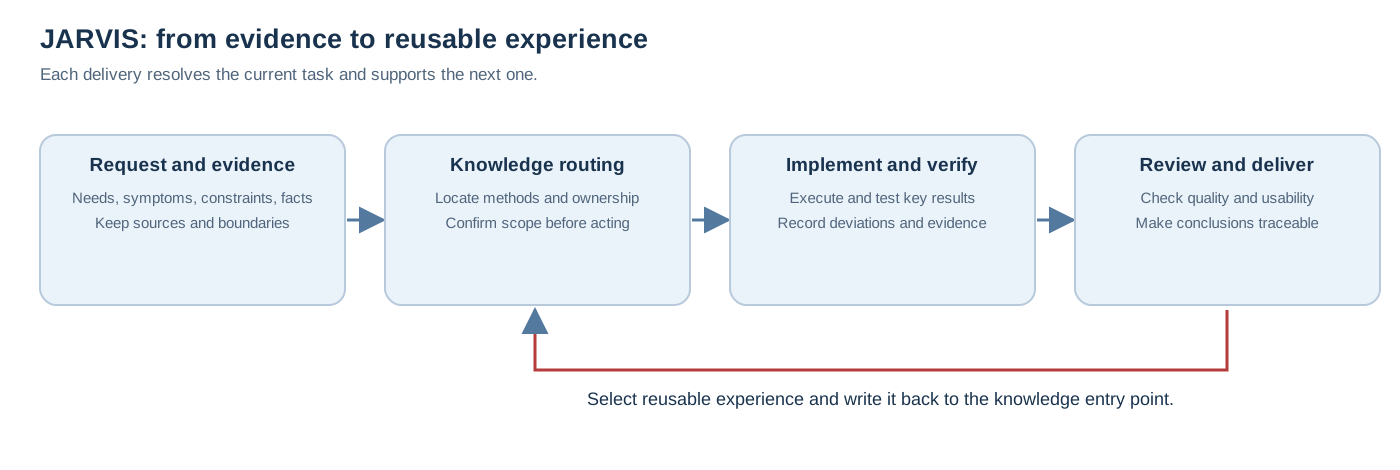
After a task, teams should select conclusions worth reusing. A stable permission-propagation rule can become a module decision. A handoff that frequently loses context can become a cross-module reference. Reusable verification steps can update a repository Skill or relevant tests.
Task-specific accounts, temporary environment state, and extensive run logs belong in task artifacts. Durable knowledge should state the rule, source, applicability, and maintenance responsibility, avoiding the promotion of a case-specific inference into a product definition. Agents can prepare candidate updates for the relevant maintainers to review through existing processes.
Feedback should also inform workflow improvement. Repeated rework caused by unclear requirements calls for better inputs. Repeated omissions of a consuming channel call for better impact checks. A test that misses the real trigger calls for a change in verification. Execution evidence can therefore improve both knowledge and process.
5. Expand gradually through verifiable outcomes
JARVIS adoption can start with a frequently used module, one fault category, or a documentation workflow. The first delivery should include usable knowledge entry points, repository rules, workflow templates, owners, and acceptance conditions, validated through actual tasks.
Once that path is stable, expand to cross-repository collaboration and tool integration, adding regression tests and review mechanisms. Track clarification exchanges, time from reproduction to verification, causes of review rework, and recurring problems. Comparisons should use comparable task types and acceptance criteria, with manual intervention and environment waits recorded, rather than focusing only on generated code volume or model call counts.
HENGSHI capabilities have distinct responsibilities here: HENGSHI SENSE and Data Agent serve business data analysis; HENGSHI CLI provides access to authorized BI engineering operations; JARVIS helps teams organize knowledge, working methods, and delivery responsibilities. Enterprises can combine them for their scenarios, with integration scope, runtime environment, and automated steps defined in the implementation plan.
When accepting Agent work, teams need both an outcome and the ability to trace its basis, inspect results, and maintain it. JARVIS brings those requirements into knowledge indexes, workflows, run materials, and writeback mechanisms, helping enterprises accumulate reusable engineering capability through actual tasks.