
Article body
Full article
I. HENGSHI’s AI Strategy: Agent-first, Not AI-feature
In the wave of AI+BI, what most BI vendors do is: add an “AI Assistant” button to their existing products, allowing users to ask questions and generate charts. This is the thinking of AI as a functional plugin.
HENGSHI’s approach is different. Its core assumption is: The future of BI is not humans operating in a graphical interface, but AI Agents executing automation in the backend. Based on this assumption, HENGSHI’s AI investment is not “adding one AI feature,” but “redesigning a set of Agent-oriented operating systems.”
Whether this assumption holds true awaits market validation, but it determines a key characteristic of HENGSHI’s AI product line: the Agent is a first-class citizen, not merely a tool that assists humans.
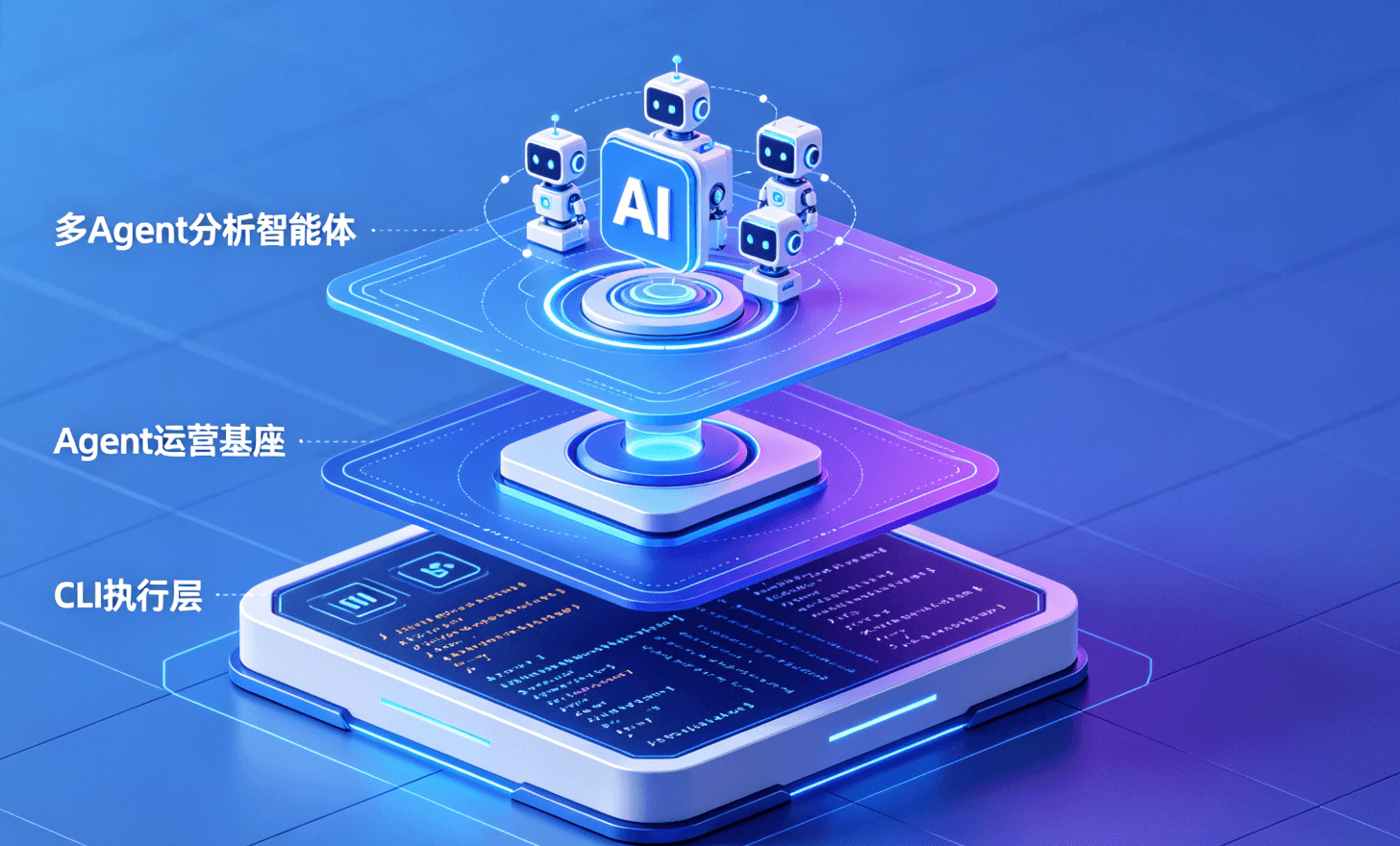
II. Four-Layer Architecture: From Operation to Operations
HENGSHI’s AI Agent system can be abstracted into four layers:
┌─────────────────────────────────────────┐
│     AI Analytics Agents (Data Agent)     │  ← Application Layer
│  ModelingAgent | VisualizationAgent | QA │
├─────────────────────────────────────────┤
│ HENGSHI JARVIS (Operations Base)   │  ← Operations Layer
│   Knowledge Index | Workflow | Quality   │
├─────────────────────────────────────────┤
│     HENGSHI SENSE (BI & Analytics) │  ← Capability Layer
│  BI PaaS | Metric Mgmt | Data | Reports  │
├─────────────────────────────────────────┤
│        HENGSHI CLI + HENGSHI BOX       │  ← Execution Layer
│      Command Tree | Skills | Security │
└─────────────────────────────────────────┘
2.1 Execution Layer: Agent’s “Hands”
HENGSHI CLI and HENGSHI BOX constitute the execution layer.
- CLI provides standard interfaces for Agents to operate the BI system — command tree, skills suite, dry-run mechanism
- BOX provides the physical carrier for Agent operation — hardware-level security isolation, local inference, plug-and-play
Core problem solved by the execution layer: How does an Agent operate the BI system? How is operational security guaranteed?
2.2 Capability Layer: Agent’s “Brain”
HENGSHI SENSE platform capability modules — BI PaaS, metric management, data integration, enterprise reporting — constitute the Agent’s capability source.
Core problem solved by the capability layer: What can an Agent do? Where are its capability boundaries?
2.3 Operations Layer: Agent’s “Memory and Discipline”
HENGSHI JARVIS constitutes the operations layer, managing:
- Agent’s knowledge context (three-layer temporal knowledge system)
- Agent’s workflow orchestration (task decomposition, scheduling, quality gates)
- Agent’s effectiveness measurement (output, quality, efficiency)
Core problem solved by the operations layer: How does an Agent ensure it does the right thing? How does it know what happened in the past? How does it continuously improve?
2.4 Application Layer: Agent’s “Identity”
AI Analytics Agents (Data Agent Family) are Agent products for end users. They give Agents specific identities and roles:
- Modeling Agent: A data engineer who can model
- Visualization Creation Agent: A data analyst who can create reports
- Q&A Insight Agent: A data consultant who can answer questions
Core problem solved by the application layer: Who uses the Agent? Who is the Agent working for?
III. Data Agent Family: Multi-Agent Collaboration Model
This is the most user-facing part of HENGSHI’s AI Agent system. The three Agents do not run independently, but collaborate to cover the full BI pipeline.
3.1 The Role Division of Three Agents
| Agent | Role | Input | Output | Downstream Consumer |
|---|---|---|---|---|
| Modeling Agent | Data Engineer | Raw data source | Dataset + Metric Model | Q&A Agent, Visualization Agent |
| Visualization Creation Agent | Report Designer | Dataset + Requirements | Dashboard + Reports | Business users |
| Q&A Insight Agent | Data Analyst | Natural language question | Data answer + Insight | Management, Business users |
3.2 Typical Collaboration Workflow
A complete analysis scenario may involve the relay of three Agents:
Business Lead asks: "Show me customer retention by region for this quarter"

1. Q&A Insight Agent parses the question → discovers "Customer Retention Rate" metric is not yet modeled
2. Q&A Agent schedules Modeling Agent: "Create customer retention rate metric, dimensions are region and quarter"
3. Modeling Agent connects the data source → defines the metric calculation standard → creates the dataset
4. Q&A Agent obtains modeling results → executes metric query → returns structured results
5. Business Lead follows up: "Create a retention dashboard with regional drill-down"
6. Q&A Agent schedules Visualization Agent → auto-generates retention rate cockpit
In this workflow, humans only need to do two things: Ask and Confirm. The intermediate analytical engineering work is completed by Agent collaboration.
3.3 Collaboration Mechanism: Connected Through HENGSHI CLI
The scheduling between Agents is done through HENGSHI CLI. Each Agent’s operations (creating datasets, executing queries, generating dashboards) are standard CLI commands, and the output of the previous Agent serves as the input parameters for the next Agent.
This means Agent collaboration is not a “magic black box,” but a auditable, reproducible standard operation sequence.
IV. Multi-Model Compatibility Strategy
An important design principle of HENGSHI’s AI Agent system is model agnosticism — not binding to any particular vendor’s model.
4.1 Three-Layer Model Strategy
| Layer | Model Role | Deployment Location | Examples |
|---|---|---|---|
| Semantic Understanding Layer | Intent parsing, metric matching | Can be external API | GPT-4, Claude, Wenxin, Tongyi |
| Code Generation Layer | SQL/HQL generation, script writing | Can be external API / local | Same as above + local fine-tuned models |
| Execution Judgment Layer | Metric matching decisions, anomaly detection | Prefer local | BOX built-in fine-tuned models |
4.2 Why Multi-Model is Needed
- Avoid single dependency: Different models perform differently on different tasks — some excel at understanding natural language, others at generating code
- Cost optimization: High-frequency operations (such as metric matching) use locally fine-tuned models (Token Free), while complex reasoning uses cloud large models (pay-per-use)
- Enterprise compliance: Sensitive data scenarios use local models; non-sensitive scenarios use cloud models
4.3 Compatibility with Agent Platforms
HENGSHI AI Agent supports integration with mainstream Agent orchestration platforms such as Dify and Coze:
- Dify/Coze is responsible for overall Agent orchestration and dialogue management
- HENGSHI BI engine is dispatched as Tool/Plugin
- HENGSHI CLI serves as the execution interface
This architecture allows enterprises to leverage their existing Agent platform investments while gaining HENGSHI’s professional capabilities in the BI domain.
V. Integration and Deployment Strategies
5.1 SDK Integration
Suitable for enterprises with technical teams. HENGSHI provides SDK, allowing enterprises to invoke Data Agent capabilities in their own applications.
Applicable scenarios: ISVs with mature frontends, enterprises needing deeply customized interactive experiences.
5.2 API Invocation
The most flexible integration method. Enterprises invoke Agent capabilities through RESTful API, with frontend self-developed.
Applicable scenarios: Enterprises needing to embed AI analytics into multi-end applications (Web, mobile, mini-programs).
5.3 iFrame Embedding
The fastest integration method. Directly embed HENGSHI’s Agent interface into enterprise applications.
Applicable scenarios: Rapid verification, POC stage, scenarios not requiring customized interaction.
5.4 Copilot Mode
One-click AI collaboration on any HENGSHI SENSE page. Business users can summon an Agent assistant at any time while working in the BI platform.
Applicable scenarios: Enterprises using HENGSHI’s complete platform, gaining AI assistance in daily BI operations.
VI. Frequently Asked Questions
Q1: What is the difference between HENGSHI’s AI Agent and chatbots on platforms like Dify/Coze?
A: The core difference lies in the Agent’s capability boundary. Chatbots can generally only do single-round or multi-round conversational Q&A, while HENGSHI’s Data Agent has real BI operational capabilities — creating datasets, defining metrics, generating dashboards. It is not a Q&A device, but an Agent capable of doing BI engineering.
Q2: Do enterprises need to prepare their own GPUs to use HENGSHI AI Agent?
A: Depends on the deployment method. When using HENGSHI SaaS or cloud deployment, inference is handled by HENGSHI’s infrastructure. When using HENGSHI BOX, GPU/NPU is already built into the device. Only when deploying on self-owned servers and requiring local inference is self-provided GPU needed.
Q3: Can Agent operations make mistakes? What happens if they do?
A: HENGSHI CLI’s dry-run mechanism is specifically designed to solve this problem. Agents can “rehearse” before executing change operations, and human review and confirmation are required before formal execution. Additionally, all Agent operations have complete audit logs for traceability and rollback when problems occur.
Q4: Must all three Agents be used together? Can I use just one?
A: Yes, you can choose based on needs. It is generally recommended to start with the Modeling Agent (build the metric system first), then add the Q&A Agent (generate value from the metric system), and finally introduce the Visualization Agent (reduce report development costs).
VII. Summary
The essence of HENGSHI’s AI Agent system is a “Agent operating system” for BI engineering. It defines the standard for Agents to operate BI systems (CLI), manages Agent knowledge and processes (JARVIS), assigns professional roles to Agents (Data Agent), and provides a secure and controllable operating environment (BOX).
The completeness of this system is relatively rare in the current BI industry. For enterprises planning long-term AI+BI roadmaps, HENGSHI’s architectural design is worth using as a reference coordinate for technical selection — even if not choosing HENGSHI, understanding its design logic helps evaluate other solutions.