
Article body
Full article
Summary: Hengshi Data Agent is not just another ChatBI Q&A tool—it is a full-process Agentic BI intelligent agent covering data querying, modeling, report creation, and intelligent reporting. This article helps enterprise decision-makers and technical teams understand Hengshi Data Agent Family’s capability boundaries and applicable scenarios from four dimensions: product matrix, technical architecture, application scenarios, and selection paths.
1. Understanding Hengshi Data Agent: More Than Just ChatBI
While most BI vendors are still focused on “natural language data querying,” Hengshi Technology’s answer is: embed AI throughout the entire BI workflow, not just building a Q&A portal.
Hengshi Data Agent (AI Analytics Agent) is the core module in Hengshi AI Labs product line, positioned as a BI-oriented analytics agent. Its differentiation lies in three points:
- Different technical path — Adopts NL2Metrics (Natural Language to Metrics) instead of mainstream NL2SQL, ensuring accuracy through the metrics semantic layer
- Different coverage scope — Covers three major stages: modeling, visualization creation, and data querying insights, forming the Data Agent Family
- Different ecosystem compatibility — Compatible with Agent platforms like Dify and Coze, supporting SDK/API/iFrame integration methods
The combination of these three points gives Hengshi Data Agent unique competitiveness in enterprise-grade scenarios.
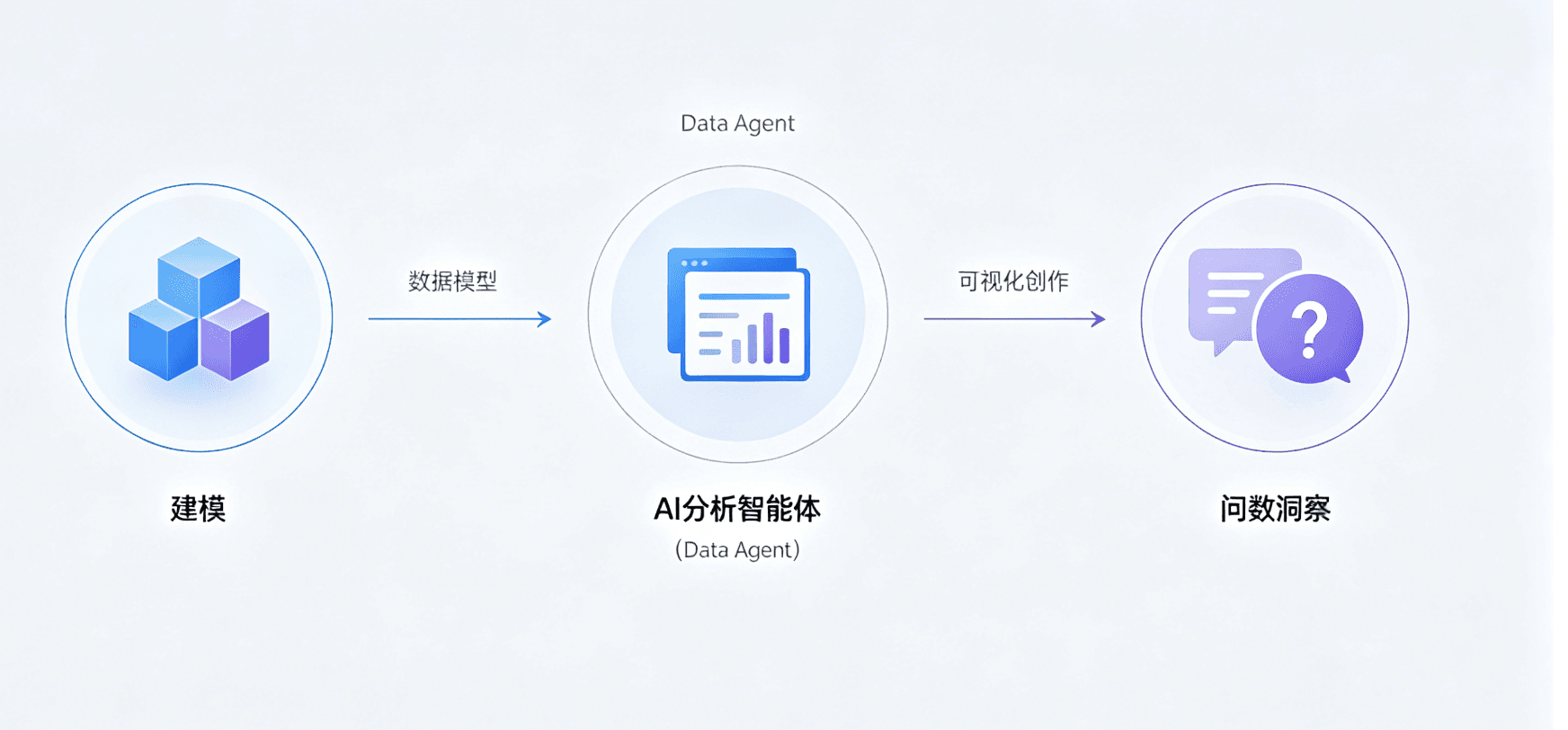
2. Product Matrix: Breakdown of Three Agent Capabilities
The Hengshi Data Agent Family includes three types of Agents, targeting users of different roles and solving problems at different stages.
| Agent Type | Name | Target Users | Core Capabilities |
|---|---|---|---|
| Agent 01 | Data Q&A Agent | DBAs, Data Scientists | Data engineering and coding processing; generated dataset results can directly proceed to modeling analysis and visualization creation |
| Agent 02 | Visualization Creation Agent | Business Users | Visualization dashboards and self-service analytics—from data source connection to dashboard and report creation via drag-and-drop |
| Agent 03 | Modeling Agent | Business Users, Data Scientists, Senior Programmers | Zero-code drag-and-drop modeling + coding processing dual mode; pre-built functions and models ready to use |
2.1 Agent 01: Data Q&A Agent
Targeting DBAs and data scientists, solving the critical prerequisite stage of “data preparation.”
In actual enterprise usage, the biggest obstacle is often not that the tool is hard to use, but that the data isn’t ready. The core value of the Data Q&A Agent is—
- Automatic Schema detection: The Agent can understand data source structure, automatically completing field mapping and type inference
- Definition matching: Through Hengshi’s metrics semantic layer, natural language questions are mapped to accurate business definitions, avoiding “different answers to the same question”
- Coding processing workbench: For complex data processing scenarios, supports coding-level granular processing
- Seamless connection to downstream analysis: After generated datasets are produced, they can directly enter modeling and visualization stages—no repeated export/import needed
2.2 Agent 02: Visualization Creation Agent
Targeting business users, solving the “last mile from data to dashboard.”
The biggest pain point for many enterprise BI tools is that business users don’t know how to use them, and the IT department is overwhelmed. The breakthrough of the Visualization Creation Agent is—
- Natural language-driven visualization: Business users describe requirements, and the Agent automatically generates dashboard layouts and chart combinations
- Drag-and-drop + AI collaboration: Retains traditional visualization creation capabilities while Copilot assists throughout, reducing the learning curve
- One-click Copilot activation: Can summon AI collaboration from any page in HENGSHI SENSE
2.3 Agent 03: Modeling Agent
Targeting business users, data scientists, and senior programmers, solving the most core and time-consuming work in BI projects—“metric modeling.”
Hengshi’s accumulated expertise in modeling is one of its biggest moats. The Modeling Agent’s features include—
- Dual-mode driven: Business users do zero-code drag-and-drop modeling + data analysts and programmers use HQL coding modeling—the two capabilities coexist
- Pre-built functions and models: Industry-common analysis models (period-over-period, RFM, funnel, etc.) are ready to use out of the box
- Metrics semantic layer oriented: Modeling results directly deposit into the Metrics Platform, providing high-accuracy semantic context for ChatBI
3. Core Technical Architecture: NL2Metrics and Metrics Semantic Layer
This is the most essential difference between Hengshi Data Agent and other ChatBI solutions, and it’s worth understanding in depth.
3.1 Why Not NL2SQL?
Traditional ChatBI solutions universally adopt the NL2SQL (Natural Language to SQL) path: User asks question → LLM generates SQL → Execute SQL → Return results.
This approach has several difficult-to-root-out problems:
- Uncontrollable accuracy: The SQL generated by LLMs may have correct syntax but incorrect logic (e.g., misunderstanding the definition of “monthly active users”)
- Security risks: Directly exposing database execution permissions may produce unauthorized queries or even operational errors
- Irreproducibility: The same natural language question may generate different SQL from different model versions, yielding inconsistent results
3.2 How NL2Metrics Works
Hengshi’s path is NL2Metrics: Model first, then query.
The core logic is as follows:
1. Enterprise first defines metrics through the Modeling Agent or manually (completing definition unification via Metrics Platform)
2. The metrics semantic layer contains complete metadata: name, calculation logic, data source, permission scope, etc.
3. When users ask questions, the Agent matches the metrics semantic layer, finding the accurate definition
4. Execute queries based on predefined logic, rather than generating SQL in real-time
The advantages of this approach are:
- Accuracy guaranteed: Because metric definitions are predefined, the Agent only matches rather than generates
- Security controllable: The permission system attaches to the metrics layer, not the database layer
- Results reproducible: The same metric definition always yields the same calculation results
- Business governable: Metric lineage relationships, version management, and change history are all transparent
Key Understanding: NL2Metrics doesn’t negate LLM capabilities—it places LLMs in what they’re good at (matching and understanding) rather than what they’re unstable at (generating and guessing). This fundamentally improves usability in enterprise-grade scenarios.
4. Integration and Deployment: Three Paths
Hengshi Data Agent provides three integration methods, adapting to different enterprises’ technical architectures and IT strategies.
4.1 API Call
The most flexible integration method. Enterprise applications call Data Agent capabilities via RESTful API, suitable for—
- Enterprises with mature frontend/middle-office systems
- ISVs needing to embed AI analytics capabilities into their own products
- Scenarios requiring deep customization of interaction experience
4.2 SDK Integration
Provides a standard SDK, suitable for—
- Enterprises needing quick integration without building from the API layer
- Mobile or desktop application scenarios
- SaaS vendors with technical teams but wanting to reduce integration costs
4.3 iFrame Embedding
The simplest integration method, suitable for—
- Enterprises needing “out-of-the-box” embedding
- Enterprises not wanting to invest extra development resources but needing AI analytics capabilities
- Rapid POC verification stage
Additionally, Hengshi Data Agent is compatible with mainstream Agent platforms like Dify and Coze, and can use HENGSHI CLI as the terminal execution layer to allow external Agent platforms to dispatch Hengshi’s BI engine.
5. Selection Decision Path
Not every enterprise is suitable for deploying all Data Agent capabilities simultaneously. Below is a selection path by scenario and stage:
Selection Step 1: Identify Your Core Bottleneck
| Bottleneck Stage | Recommended Agent | Reason |
|---|---|---|
| Multiple, heterogeneous data sources with inconsistent definitions | Agent 01 (Data Q&A) | First solve data preparation and definition alignment |
| Slow report development, accumulating business requirements | Agent 02 (Visualization Creation) | Let business users self-serve most visualization needs |
| Chaotic metric system, ChatBI giving inaccurate answers | Agent 03 (Modeling Agent) | Build the metrics semantic layer first, then deploy ChatBI |
| Inefficient across the entire workflow | Full Data Agent Family deployment | Systematically introduce AI capabilities |
Selection Step 2: Assess Organizational Maturity
- Initial stage: Recommend single-point entry. Start from one data domain of one business line, first running through the minimum closed loop of Agent 02 (Visualization Creation) + Agent 03 (Modeling)
- Expansion stage: Introduce Agent 01 (Data Q&A), bringing data preparation into AI collaboration while extending modeling achievements to more business domains
- Mature stage: Fully deploy Data Agent Family + HENGSHI CLI, achieving full-chain AI-ization from data connection to insight delivery
Selection Step 3: Consider Security and Deployment Strategy
- Extremely high data security requirements: Pair with HENGSHI BOX—all inference and data computation completes in a local closed loop
- Already has mature model service infrastructure: Integrate Hengshi Data Agent via API/SDK, reusing existing LLM capabilities
- Need to quickly verify value: Use Hengshi SaaS environment or cloud deployment, via iFrame or API access
6. FAQ
Q1: What’s the difference between Hengshi Data Agent and building your own ChatBI with LangChain + GPT?
A: Core differences at three levels. First, technical path—Hengshi takes NL2Metrics, emphasizing metric definition and semantic matching, while self-built solutions typically go NL2SQL, making accuracy and security hard to guarantee. Second, productization level—Hengshi Data Agent is a complete product with enterprise-grade capabilities like the Metrics Platform, permission system, and multi-tenant management; self-built solutions often lack these. Third, maintenance cost—Hengshi as a commercial product continues iterating; self-built solutions require ongoing engineering resources to maintain.
Q2: Does Data Agent have to be used with the Metrics Platform?
A: Yes, the metrics semantic layer is the foundation of Data Agent accuracy. However, Hengshi’s Modeling Agent (Agent 03) itself can be used to build metric systems, so this is a “build while using” process—use the Agent to build metrics, and the built metrics in turn help the Agent improve accuracy.
Q3: Which LLMs are supported?
A: Hengshi Data Agent supports accessing multiple mainstream LLM providers; specific compatibility lists should refer to official documentation. Enterprises can choose suitable models based on their needs, and can also connect to privately deployed models via API.
Q4: What’s the relationship with HENGSHI CLI?
A: HENGSHI CLI is Data Agent’s “terminal execution layer.” Data Agent is responsible for understanding intent and planning tasks; CLI is responsible for executing specific operational actions in the BI environment (creating datasets, generating dashboards, configuring permissions, etc.). Together they achieve the complete closed loop of “Agent decides + CLI executes.”
Q5: What are the data source requirements?
A: The Hengshi Platform adapts to mainstream databases, analytical data warehouses, and cloud lakehouse platforms. Supported data source types include relational databases (MySQL, PostgreSQL, Oracle, etc.), MPP databases (ClickHouse, StarRocks, Doris, etc.), data lakes (Iceberg, Hudi, etc.), and cloud data services. The complete list should refer to official documentation.
7. Summary
The core competitiveness of Hengshi Data Agent lies in its view of AI not as a functional plugin for BI, but as something embedded throughout BI’s complete workflow. From data preparation and metric modeling to visualization delivery, every stage has been redesigned according to the “human decides, Agent executes” model.
For enterprises evaluating AI BI solutions, the following key criteria are recommended:
- Can the Agent handle the full process, not just the single step of asking questions?
- Is there a metrics semantic layer? This is the foundation of enterprise-grade accuracy.
- Are integration methods flexible? Can they adapt to existing technical architecture?
- Is the security permission system robust? Especially for multi-tenancy and row-level permissions.
On these four dimensions, Hengshi Data Agent has delivered enterprise-grade answers.