
Article body
Full article
When enterprises use AI for business analysis, the challenge extends beyond turning natural language into a query. Results must return to defined business rules and a clear checking path. An answer to “Why did profit change?” should identify the metrics used, the applicable time and data scope, the comparison baseline, and the dimensions to investigate next. Maintaining these conditions as configuration makes analysis reviewable even as people, conversations, and versions change.
“Analytical method” here means neither a model’s hidden reasoning nor a profit-attribution or sales-funnel recipe assumed to be validated for every enterprise. It means an analytical path jointly maintained by business and data teams: the question, metrics, applicable boundaries, comparison conditions, breakdown order, and delivery limits. HENGSHI positions metric management as “define once, use across teams, unify definitions,” and describes HQL as decoupling data storage and computation from metric logic. This provides a foundation for maintaining business methods alongside metric assets.
1 Turn analytical methods into maintainable paths
An ad hoc prompt can help a user complete a question, but is difficult to maintain as a reviewable long-term asset. If a model improvises an explanation for a quarterly gross margin decline, it may overlook returns, currency conversion, organizational scope, or closing status. Even a plausible explanation may use different conditions from the previous period. An analytical path should specify what to confirm first, what to compare next, and when to stop explaining, as checkable agreements.
| Configuration | Question it should answer | Maintenance responsibility |
|---|---|---|
| Analytical objective | Explain a change, locate an anomaly, or draft a regular review? | Business owner |
| Metric semantics | What are the formula, filters, granularity, version, and owner? | Metric owner |
| Data scope | Which datasets, organizations, periods, currencies, and snapshots apply? | Data owner |
| Comparison baseline | Year-over-year, period-over-period, budget, or historical range; are conditions consistent? | Business and analytical staff |
| Analytical path | What should be validated first, and which dimensions should follow? | Analysts |
| Delivery boundaries | Which conclusions need verification, and who reviews them before use? | Business owner |
For recurring business questions, administrators can extend business methods and tool-use guidance through runtime skills in HENGSHI 7.0. Skills are uploaded as ZIP packages containing a directory named after the skill ID, with SKILL.md and optional references. Administrators upload, enable, disable, and roll back versions. A new version can replace the currently enabled version of the same skill, while each new task uses a snapshot of the enabled skills at startup. Teams should retain the enabled version in change and validation records so they can trace the business method used for an analysis.
This does not mean moving old prompts wholesale into the new system. Each rule should specify its applicable data scope, metric definitions, boundary conditions, owner, and representative questions. Legacy tuning prompts and Workflows are not automatically converted into 7.0 runtime skills. Migration should remove obsolete rules before validating new versions against controlled data. These implementation boundaries follow the HENGSHI SENSE 7.0 Data Agent and Runtime Skill Extensions manuals checked for this article.
2 From metrics to interpretation: maintain definitions, knowledge, and methods separately
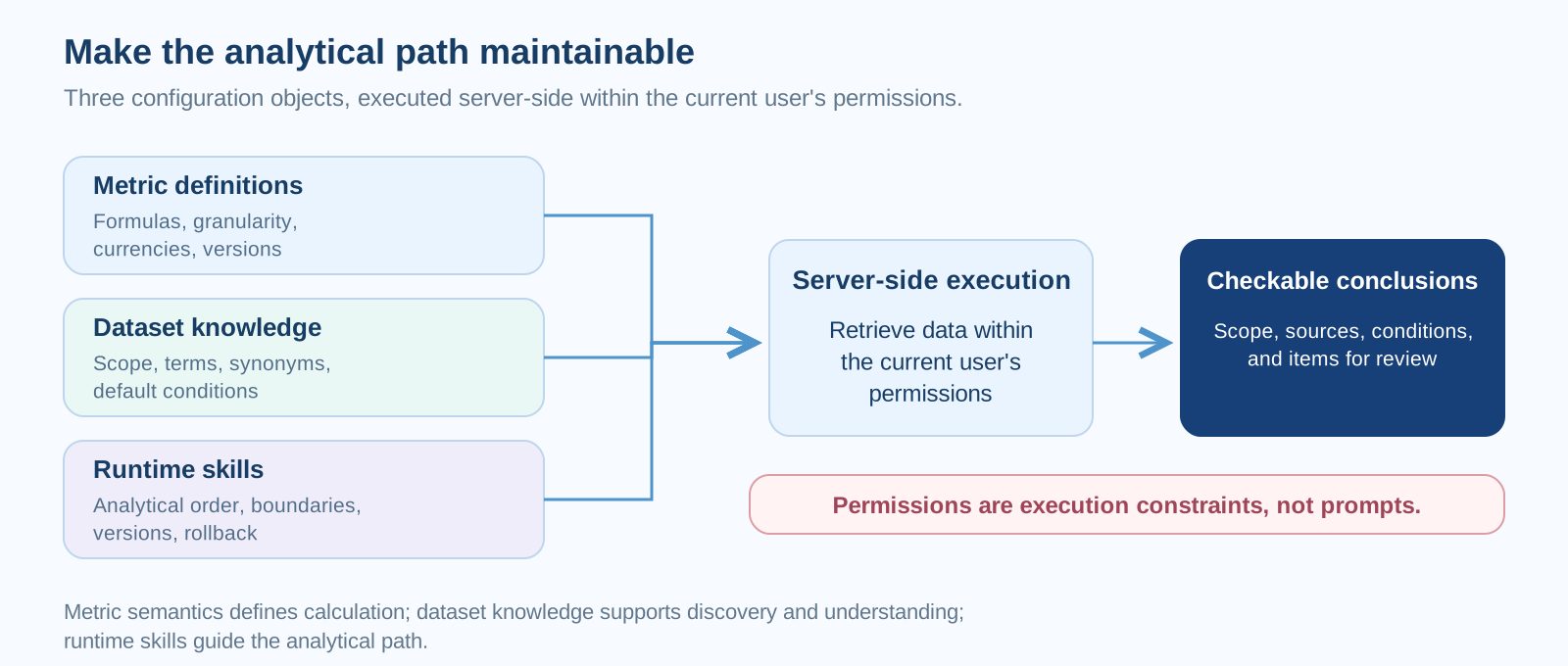
2.1 Metric semantics: what the number means
Metric semantics maps business names to reusable calculation definitions. For gross margin analysis, a team might define whether net revenue deducts returns, allowances, and agreed taxes; which cost centers are included in operating costs; gross profit as net revenue minus operating costs; and gross margin as gross profit divided by net revenue. Display behavior when net revenue is zero should also be agreed in advance. These are examples of business definitions, not formulas that automatically fit every enterprise, accounting standard, or management context.
Semantics also needs context. Monthly versus quarterly aggregation, CNY versus foreign-currency conversion rules, legal entities versus operating organizations, and closed accounts versus live transactions can all change a number’s meaning. HENGSHI’s website identifies NL2Metrics and the modeling semantic layer as central to its conversational analytics architecture, alongside security and access control. Natural-language querying cannot bypass these governance conditions.
2.2 Dataset knowledge management: where to look and how to understand
Dataset knowledge management prepares semantics: it describes dataset purpose and coverage; completes field, metric, relationship, and business definitions; and records default filters, time granularity, metric formulas, and synonyms. It helps the system associate terms such as “collections,” “actual receipts,” and “funds received” with appropriate data objects, while helping maintainers identify questions outside the current data scope.
Knowledge management must not silently change metric calculations. If sales attainment has both an annual-target version and a rolling-forecast version, metric definitions and versions should distinguish them first; knowledge then explains aliases and applicable scenarios. The 7.0 manual also calls for complete field and metric descriptions, with explicit business formulas, units, and time granularity. Knowledge improves discovery and understanding; metric semantics determines calculation definitions.
2.3 Intelligent interpretation configuration: how to present established facts
Intelligent interpretation can organize agreed metrics, comparison windows, and breakdown order into a descriptive analytical draft. For example, first check data freshness and comparability, then present gross margin changes, then list contributions by product, region, or channel for review. In HENGSHI SENSE 7.0, a saved dashboard accessible to the current user can start intelligent interpretation. The system creates a read-only conversation scoped to that dashboard and takes visible filters into account. Page filters are analytical hints and cannot bypass server-side data permissions.
This example uses intelligent interpretation to organize existing and historical data, flag anomalies, and assist analysis. Forecasting future trends requires separate validation of the forecasting method, its applicability, and its error. Attribution across definitions, forward-looking forecasts, and major business decisions need additional assumptions, external evidence, and human review. The website describes combining intelligent metric exploration with AI Agents for anomaly analysis and attribution. These capabilities should support checking and organizing analysis without replacing accountability for business decisions.
The following is a SKILL.md example for a 7.0 runtime skill. Save it as gross-margin-review/SKILL.md and package the gross-margin-review directory as a ZIP. Enterprises must validate the example business rules. This is neither a built-in profit definition, HQL, an API, nor a display of hidden reasoning.
---
name: gross-margin-review
description: Guidance for checking and reviewing gross margin changes in closed quarters
---

# Gross margin review

## Applicable scope
- Use a confirmed closing snapshot; aggregate fiscal months into fiscal quarters.
- Compare only the same legal entities, operating organizations, and data scope authorized for the executing user.
- Use approved CNY conversion rules and metric definition versions consistently.

## Metric agreement
- Reuse the enterprise's published net revenue definition; do not recalculate deductions ad hoc.
- Gross profit = net revenue - operating costs; gross margin = gross profit / net revenue.
- When net revenue is 0, follow business display rules rather than calculating a meaningless ratio.

## Analytical order
1. State the period, units, scope, snapshot, and query source first.
2. Compare year-over-year or period-over-period only under consistent conditions, then break down by product, region, and channel.
3. List items requiring review; do not forecast or replace human review.
3 Comparability and permissions depend on execution conditions
Identically named metrics do not automatically return identical numbers under every condition. Values become comparable only when time granularity, currency and conversion rules, organizational and data scope, filters, the executing identity’s data permissions, and the data snapshot or refresh status are the same. Different metric versions, closed snapshots, and live transactions should not be treated as one baseline. When conditions are insufficient, mark the result as awaiting verification instead of forcing attribution.
Permissions cannot depend on a sentence in a skill prompt. The 7.0 Data Agent’s model and tool loop, permission checks, history, and task management all run on HENGSHI’s server. Data access and operational permissions follow platform configuration. Skills can guide analysis of authorized data, but cannot increase data or write permissions. Selected scope, mode, and model configuration identifier are fixed when a conversation is created. Changes to model configuration content can take effect from the next turn; changing scope or mode requires a new conversation. Before release, use real roles to verify data-object visibility, row-level scope, and sensitive-field presentation, and retain permission tests separately from definition tests.
4 Make methods an evolving team asset
Start with one frequent question whose data pipeline is stable and whose owner is clear. Establish minimum metric semantics, dataset knowledge, and runtime skills, then prepare human-confirmed typical and boundary questions as regression examples. Whenever metric formulas, field meanings, synonyms, data permissions, currency rules, or snapshot logic change, revalidate conclusions, scope descriptions, and permission outcomes. To roll back, disable the new skill version and enable a retained version. Tasks already started continue to use their startup skill snapshot.
Business owners should approve definitions, baselines, and interpretation boundaries. Data owners maintain dataset knowledge, refresh status, and permissions. Analysts maintain breakdown paths and report structure. HENGSHI’s website also lists data interpretation and report generation among Data Agent’s augmented capabilities. Building these capabilities on clear metrics and rules makes interpretation a traceable analytical asset that teams can improve.